
Key Insights
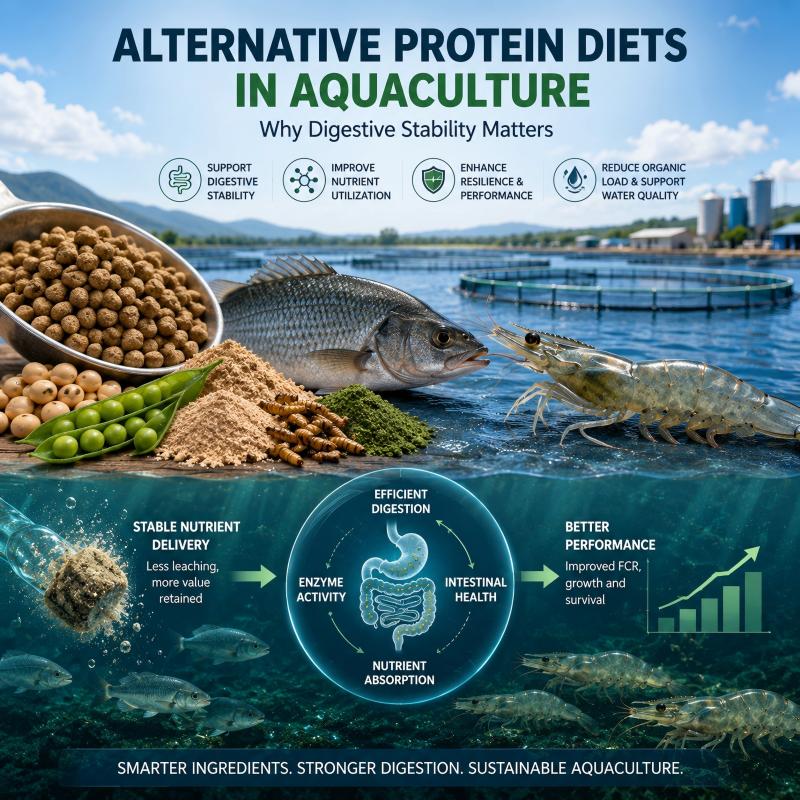
- Alternative protein diets in aquaculture change protein-release speed, enzyme demand, and nutrient retention—not only feed cost.
- When alternative proteins exceed digestive tolerance, undigested nutrients become a source of microbial and water-quality pressure.
- Digestive stability determines whether fishmeal replacement improves formulation flexibility or creates unstable FCR and biomass outcomes.
Why Alternative Protein Diets Create a Digestive Challenge
Fishmeal replacement is now a core direction in aquaculture feed formulation. Soybean meal, rapeseed meal, pea protein, DDGS, insect meal, and single-cell proteins can improve raw-material flexibility in fish and shrimp production.
But replacing fishmeal is not a simple protein-for-protein exchange.
Alternative ingredients differ in protein solubility, amino acid availability, fiber level, palatability, and anti-nutritional factor load. A formula can meet crude-protein targets on paper while becoming biologically unstable after feeding.
For a broader view of fermentation-derived ingredients in aquatic feed programs, see our guide to yeast culture for aquaculture.
The Real Problem: Digestive Mismatch
The issue is not plant protein itself. The issue is whether the finished formula matches the animal’s digestive capacity.
Higher inclusion of complex proteins can increase exposure to non-starch polysaccharides, phytate, trypsin inhibitors, lectins, and variable protein structures. These factors increase digestive workload and can slow nutrient release.
Higher alternative-protein inclusion → incomplete enzymatic breakdown → more undigested substrate → microbial and organic-load pressure → lower feed-use stability
In both fish and shrimp production, digestive mismatch reduces nutrient-utilization consistency and increases organic-load pressure.
In shrimp feed, the effect is often more immediate because the hepatopancreas must continuously coordinate digestive enzyme synthesis, nutrient processing, lipid metabolism, and detoxification.
When protein digestion becomes inconsistent, farms often see slower feeding response, wider FCR variation, uneven growth, and lower harvest uniformity.
Alternative Protein Diet Risk
| Formulation Pressure | Biological Mechanism | Production Outcome |
|---|---|---|
| High plant-protein inclusion | Higher NSP and anti-nutritional factor exposure | Reduced enzyme efficiency and slower nutrient release |
| Variable raw-material quality | Inconsistent protein solubility and amino acid availability | Batch-to-batch FCR variation |
| Incomplete protein digestion | More undigested substrate enters the distal digestive tract | Higher organic waste and microbial instability |
| Reduced palatability | Lower feeding response during stress periods | Uneven growth and reduced biomass gain |
| Excessive dietary complexity | Greater metabolic demand on digestive organs | Lower tolerance to water-quality fluctuation |
Why Digestive Stability Matters More in Aquatic Feed
Aquatic feed enters water before it is consumed. This creates a narrower margin for formulation error.
If nutrients leach from pellets before feeding, and remaining protein is also digested inefficiently, feed value is lost twice: first from the pellet, then inside the animal.
Poor digestibility does not remain inside the animal. It re-enters the production system as water-quality pressure.
Unused protein and organic residues increase biological oxygen demand and ammonia-generation potential. In intensive fish and shrimp systems, this adds pressure to digestive function, feeding behavior, and pond microbial balance.
This feed-driven pressure also connects directly with the issues discussed in supporting gut health in intensive shrimp farming.
How Yeast Culture Supports Alternative Protein Utilization
Yeast culture does not replace formulation discipline or raw-material quality control. Its role is to improve the functional tolerance of complex diets when raw-material variation cannot be completely eliminated.
1. Supporting Enzyme-Compatible Nutrient Utilization
Fermentation-derived metabolites provide small peptides, nucleotides, and accessible nutritional factors that support digestive continuity.
When alternative proteins create uneven nutrient-release patterns, maintaining coordinated activity of proteases, lipases, and amylases becomes essential. Stable metabolite delivery supports more consistent nutrient processing and reduces unnecessary metabolic burden.
2. Reducing the Impact of Undigested Protein
The practical objective is not to claim complete absorption under every condition. It is to reduce the amount of protein that escapes efficient digestion and becomes unstable microbial substrate.
By supporting digestive function and, in shrimp, hepatopancreas activity, fermentation-derived nutrients help complex protein matrices move into usable metabolic pathways more consistently. This reduces downstream organic residue and feed-efficiency loss.
3. Improving Tolerance to Raw-Material Variation
Soybean meal, rapeseed meal, DDGS, and plant protein concentrates vary between batches. Their protein solubility, fiber content, processing history, and anti-nutritional factor load can change even when the formula remains the same.
A stable yeast culture fermentation profile adds functional tolerance to these shifts.
Yeast culture does not replace formulation control. It increases the biological tolerance of finished feed when raw-material variability changes digestive demand.
What Feed Manufacturers Should Evaluate
Before increasing alternative-protein levels, feed manufacturers should assess:
- Digestible amino acid profile, not crude protein alone
- Anti-nutritional factor load and raw-material consistency
- Protein solubility and particle uniformity
- Pellet water stability and nutrient-leaching behavior
- FCR consistency across commercial feed batches
The relevant question is not only whether alternative proteins reduce ingredient cost. It is whether the finished feed remains digestively stable after extrusion, water exposure, and real farm conditions.
When evaluating functional fermentation ingredients such as yeast culture, manufacturers should also verify thermal tolerance during extrusion and the ability to preserve organic matrix coherence under aquatic leaching. Functional metabolites must remain associated with the feed matrix long enough to reach the digestive tract, rather than dissolving into the water before effective nutrient utilization begins.
Conclusion
Alternative proteins are essential to the future of aquaculture feed. But fishmeal replacement only creates value when digestive stability is protected.
Managing protein-release kinetics, digestive workload, pellet-water interaction, and organic-load risk allows feed manufacturers to increase raw-material flexibility without sacrificing FCR consistency or biomass performance.