
Key Insights
- Water-quality stress reduces feed efficiency even when feed formulation and feeding rate remain unchanged.
- Ammonia accumulation, low dissolved oxygen, temperature shifts, and salinity variation redirect dietary energy away from growth.
- Stable FCR in aquaculture depends on maintaining digestion, nutrient absorption, and feeding confidence during environmental fluctuation.
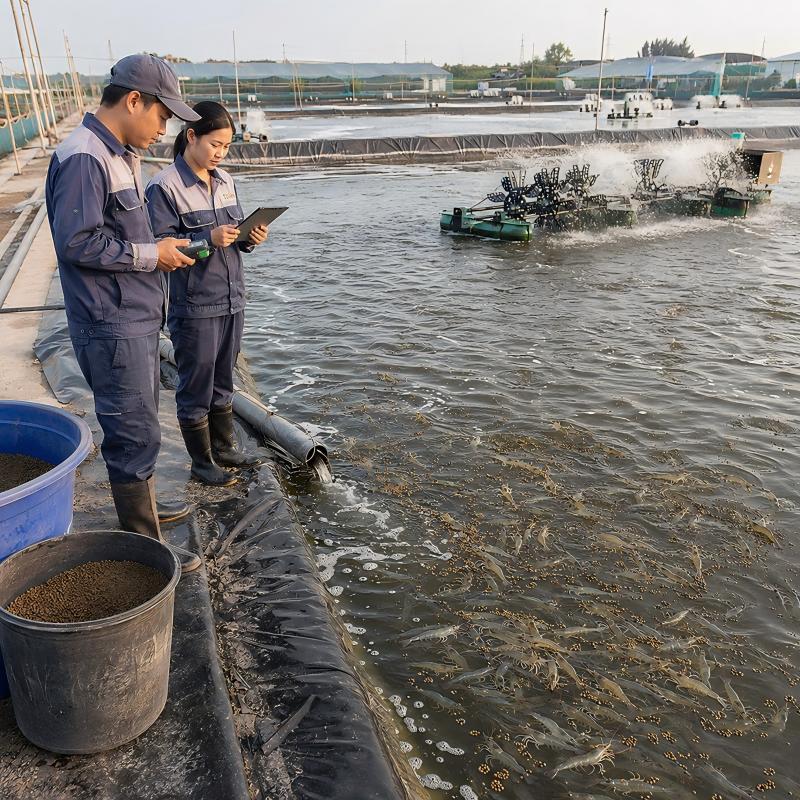
Why Feed Efficiency Drops Before Feed Quality Changes
When FCR rises, farms often first question feed quality or feeding management.
In intensive aquaculture, water quality stress can reduce feed conversion before the feed formula changes. A diet that performs well under stable pond conditions may produce inconsistent growth when ammonia rises, oxygen declines, temperature shifts, or salinity changes rapidly.
This is why water quality impact on feed conversion must be evaluated together with feed formulation and feeding rate.
The sequence is direct:
Water-quality fluctuation → stress response → lower feeding drive and enzyme activity → weaker nutrient absorption → higher maintenance energy demand → FCR deterioration
In fish and shrimp production, this reduces the proportion of dietary nutrients available for biomass gain.
For shrimp, the effect is often more visible because the hepatopancreas must simultaneously manage digestive enzyme synthesis, lipid metabolism, nutrient storage, detoxification, and environmental adaptation.
How Water Quality Stress Changes Feed Efficiency
| Water Quality Stressor | Biological Disruption | Production Outcome |
|---|---|---|
| Ammonia stress in shrimp farming | Raises detoxification demand and disrupts hepatopancreas metabolism | Lower protein utilization and wider FCR variation |
| Low dissolved oxygen impact on FCR | Restricts aerobic energy production and suppresses feeding activity | Reduced feed intake and slower biomass gain |
| Temperature fluctuation in aquaculture | Changes enzyme kinetics and nutrient-transit speed | Inconsistent digestion and unstable growth |
| Salinity variation in aquaculture feed programs | Increases osmoregulatory energy expenditure | Less dietary energy available for growth |
| High organic loading | Increases microbial pressure and oxygen demand | Poorer nutrient conversion and lower feeding confidence |
The Hidden Cost of Water Stress
Under stable conditions, dietary nutrients are mainly used for growth, tissue deposition, and feed conversion.
When water quality becomes unstable, the animal redirects more energy toward osmoregulation, ammonia detoxification, antioxidant defense, cellular repair, and survival maintenance.
Feed efficiency declines when dietary nutrients are diverted from biomass formation into environmental adaptation.
This also creates a pond-level cycle. Poor digestion increases residual organic matter, which raises biological oxygen demand, increases organic loading, and adds further water-quality pressure.
Water stress → weaker digestion → more waste → higher organic load → greater water stress
Why Shrimp Farms Have a Narrower Margin for Error
Shrimp are ectothermic crustaceans with a relatively narrow tolerance window for environmental change.
Temperature, ammonia, dissolved oxygen, and salinity shifts can quickly disrupt feeding rhythm, hepatopancreas enzyme secretion, and osmotic balance.
In intensive shrimp production, shrimp feed efficiency under ammonia stress is not determined by feed quality alone. It depends on whether the hepatopancreas can maintain nutrient processing while the animal is adapting to environmental pressure.
This is closely connected to the digestive continuity discussed in supporting gut health in intensive shrimp farming.
When digestive stability weakens, feed intake becomes less predictable, nutrient conversion declines, and biomass uniformity becomes harder to maintain.
How Yeast Culture Supports FCR Stability During Stress
Yeast culture does not replace aeration, water exchange, pond management, or feeding control.
Its value is to reduce the loss of nutrient utilization when environmental stress disrupts normal digestive performance.
Fermentation-derived metabolites provide accessible nutritional compounds that support digestive continuity when ammonia, temperature, or salinity fluctuation reduces normal enzyme efficiency.
Small peptides, nucleotides, and functional metabolites also reduce the metabolic workload required to process complex feed ingredients. This becomes especially important when environmental stress is combined with alternative protein diets in aquaculture, where ingredient complexity can further increase digestive demand.
For feed mills, functional fermentation ingredients must survive real processing conditions. They need to tolerate extrusion heat and shear while maintaining pellet water stability and nutrient retention after entering water.
If functional compounds dissolve before the pellet is consumed, their value is lost before reaching the digestive tract.
Feed Efficiency Protection Checklist
- Track FCR stability in aquaculture together with ammonia, dissolved oxygen, temperature, and salinity trends.
- Adjust feeding decisions when water stress reduces feeding confidence.
- Verify pellet water stability and nutrient retention under real pond conditions.
- Monitor raw-material changes that increase digestive workload during seasonal stress.
- Select functional fermentation ingredients based on extrusion tolerance, matrix retention, and batch consistency.
Improve Feed Efficiency Under Real Aquaculture Conditions
Maintaining feed efficiency under water quality stress requires more than increasing nutrient density.
It requires protecting the animal’s ability to digest, absorb, and allocate nutrients while environmental conditions change.
Challenge Group provides fermentation-derived yeast culture solutions for feed mills, aquaculture integrators, and distributors seeking more stable nutrient utilization under intensive production conditions.
Contact our team to discuss species-specific formulation support, processing compatibility, and customized yeast culture solutions for shrimp and fish feed programs.