
Key Insights
- Vibrio naturally exists in most shrimp farming environments, but disease outbreaks are primarily driven by the shrimp’s ability to tolerate biological stress rather than bacterial presence alone.
- Chronic Vibrio pressure disrupts oxidative balance, feeding behavior, and physiological resilience long before obvious clinical symptoms appear.
- Fermentation-derived metabolites help maintain biological stability by supporting barrier continuity, antioxidant defense, and functional immune activity under continuous environmental stress.
- Modern shrimp nutrition is increasingly shifting from disease treatment toward resilience-based nutritional management that minimizes production losses before outbreaks occur.
Introduction
Vibrio species are among the most common bacterial populations found in commercial shrimp ponds. Under balanced environmental conditions, they coexist naturally within aquatic microbial communities without causing significant production problems. However, when water quality deteriorates or animals experience continuous physiological stress, opportunistic Vibrio populations can rapidly dominate the microbial ecosystem, increasing disease pressure and reducing farm productivity.
For modern shrimp producers, the challenge is no longer eliminating bacteria from the pond—an impossible objective—but improving the animal’s capacity to remain biologically stable while continuously exposed to microbial stress.
As discussed in our guide to yeast culture for aquaculture, fermentation-derived nutritional solutions are increasingly used to improve production consistency under commercial farming conditions. In intensive shrimp systems, this strategy focuses on strengthening the animal’s biological resilience rather than reacting after disease outbreaks occur.
Why Vibrio Pressure Has Become a Major Challenge in Intensive Shrimp Farming
Intensive shrimp farming has dramatically increased production efficiency, but it has also changed the biological relationship between shrimp and their surrounding microbial environment.
High stocking densities, continuous feeding, accumulated organic matter, fluctuating dissolved oxygen, ammonia variation, and frequent temperature changes all create conditions that favor the rapid expansion of opportunistic bacteria such as Vibrio.
Unlike traditional extensive ponds, modern intensive production systems have very limited ecological buffering capacity. Shrimp depend almost entirely on formulated diets and controlled environmental management, leaving little room for natural recovery when physiological stress accumulates.
More importantly, Vibrio pressure should not be viewed simply as a bacterial challenge.
Instead, it represents a continuous biological stressor that influences multiple physiological systems simultaneously.
Once environmental stress exceeds the shrimp’s adaptive capacity, several responses occur almost simultaneously:
- Reduced feeding activity
- Increased oxidative stress
- Higher metabolic energy consumption
- Impaired epithelial maintenance
- Reduced production consistency
For this reason, successful shrimp farming increasingly depends on maintaining biological resilience rather than responding only after disease symptoms appear.
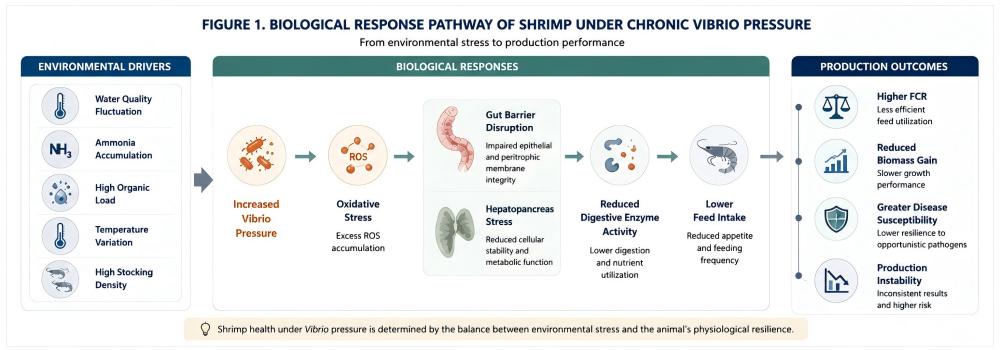
Vibrio Pressure Is a Biological Cascade, Not Simply a Bacterial Problem
Many discussions focus exclusively on bacterial counts. In practice, however, production performance is determined by the interaction between environmental stress and host physiology.
The progression typically follows a predictable biological cascade:
Environmental fluctuation → Increased Vibrio pressure → Oxidative imbalance → Barrier disruption → Reduced feed intake → Lower production efficiency
The bacterial population itself is only one component of this sequence.
As oxidative stress increases, reactive oxygen species (ROS) accumulate faster than endogenous antioxidant systems can neutralize them. Excessive ROS gradually disrupt cellular homeostasis, increasing energy demand while reducing digestive efficiency and physiological stability.
At the same time, continuous microbial pressure stimulates sustained immune activation. Instead of directing nutrients toward growth, shrimp divert metabolic resources toward maintaining basic survival functions.
Consequently, even before visible disease develops, producers often observe:
- Slower feeding responses
- Reduced growth uniformity
- Higher feed conversion variability
- Greater sensitivity to environmental fluctuations
Maintaining biological stability under chronic Vibrio pressure therefore becomes a nutritional management objective rather than a disease treatment strategy.
Production Response Under Vibrio Pressure
| Production Challenge | Biological Response | Farm-Level Consequence |
|---|---|---|
| Elevated Vibrio populations | Increased oxidative stress and immune demand | Lower feeding activity and slower growth |
| Temperature and salinity fluctuations | Disrupted cellular homeostasis | Greater susceptibility to microbial imbalance |
| High organic load and ammonia accumulation | Continuous physiological stress | Reduced production consistency |
| Long-term microbial pressure | Increased maintenance energy requirement | Higher FCR variation and lower biomass efficiency |
How Fermentation-Derived Nutrients Improve Production Resilience
Rather than acting as antimicrobial agents, fermentation-derived metabolites support the shrimp’s own physiological capacity to tolerate continuous production stress.
This resilience results from several complementary biological mechanisms.
Maintaining Gut and Hepatopancreas Integrity
In shrimp, digestive health depends not only on the midgut but also on the hepatopancreas, the primary organ responsible for digestive enzyme synthesis, nutrient storage, and metabolic regulation.
A stable hepatopancreas supports efficient secretion of endogenous proteases, lipases, and amylases, allowing nutrients to be rapidly converted into usable metabolic substrates.
Meanwhile, the integrity of the peritrophic membrane and the midgut epithelium provides an essential physical barrier that limits mechanical damage and reduces pathogen translocation during continuous bottom feeding.
Instead of directly targeting Vibrio, nutritional management aims to preserve these structural defenses so that shrimp maintain normal digestive function despite ongoing microbial pressure.
Supporting Oxidative Balance
Oxidative regulation is one of the earliest physiological responses affected by chronic Vibrio exposure.
Fermentation-derived metabolites help sustain endogenous antioxidant systems by supporting the activity of enzymes such as superoxide dismutase (SOD), catalase (CAT), and glutathione peroxidase (GSH-Px).
These coordinated antioxidant pathways improve the shrimp’s ability to neutralize excessive ROS, reducing oxidative damage to epithelial tissues and maintaining normal cellular metabolism during periods of environmental instability.
As a result, shrimp are better able to maintain feeding behavior and physiological stability even when microbial pressure remains continuously elevated.
Supporting Functional Immune Activity
Shrimp rely entirely on innate immunity, making continuous immune readiness essential under commercial farming conditions. Unlike mammals, they do not develop long-term adaptive immune memory, so maintaining consistent immune function is critical throughout the production cycle.
Functional components naturally present in yeast culture, including β-glucans, mannan oligosaccharides (MOS), nucleotides, and small bioactive peptides, help sustain this first line of defense by supporting normal hemocyte activity and microbial recognition.
Rather than creating an excessive immune response, these compounds contribute to a more balanced physiological state, allowing shrimp to respond efficiently to routine microbial challenges while avoiding unnecessary energy expenditure.
This balanced immune activity is particularly valuable in intensive farming systems, where animals are exposed to continuous environmental pressure instead of isolated disease events.
Maintaining Feeding Activity During Continuous Stress
One of the earliest indicators of Vibrio pressure is reduced feed intake.
When shrimp decrease feeding frequency, nutrient intake falls rapidly, slowing growth and increasing feed conversion ratio (FCR). Even short periods of poor appetite can significantly affect harvest weight under high-density production.
Fermentation-derived metabolites help maintain biological stability during chronic stress, allowing shrimp to sustain more consistent feeding behavior and nutrient utilization throughout production.
Because digestive efficiency, oxidative regulation, and immune function operate as interconnected physiological systems, improving overall resilience often results in more stable growth performance than focusing on a single biological target.
Why Prevention Is More Predictable Than Recovery
Modern shrimp nutrition is increasingly based on preventive resilience rather than corrective intervention.
Once severe Vibrio outbreaks occur, shrimp have already experienced prolonged oxidative stress, reduced digestive efficiency, and significant metabolic disruption. At this stage, restoring production performance becomes considerably more difficult than maintaining physiological stability from the beginning.
For this reason, nutritional programs are increasingly designed to strengthen biological resilience before environmental pressure reaches a critical threshold.
This preventive approach does not attempt to eliminate naturally occurring bacteria. Instead, it improves the shrimp’s capacity to remain productive despite unavoidable microbial and environmental challenges.
As discussed in our article on supporting gut health in intensive shrimp farming, maintaining digestive integrity is one important component of resilience. Under Vibrio pressure, however, gut stability works together with antioxidant regulation and innate immune function to support consistent production performance.
Practical Considerations When Selecting Nutritional Solutions
For feed manufacturers and shrimp producers, evaluating a fermentation-based ingredient should extend beyond its ingredient list.
Several manufacturing characteristics directly influence field performance:
- Consistent fermentation control to ensure stable metabolite composition between production batches.
- Heat-stable extracellular metabolites that retain functionality after high-temperature extrusion commonly used in aquatic feed manufacturing.
- Low nutrient leaching characteristics, allowing functional compounds to remain associated with the feed matrix during water exposure instead of rapidly dispersing into the pond.
- Reliable production quality supported by standardized fermentation and quality-control systems.
These factors determine whether nutritional functionality is consistently delivered under commercial farming conditions rather than only under laboratory testing.
Conclusion
Vibrio pressure is an unavoidable component of modern shrimp farming, but disease outcomes are largely determined by the animal’s ability to maintain biological stability under continuous environmental stress.
Instead of targeting bacteria alone, effective nutritional strategies focus on preserving oxidative balance, digestive function, and innate immune readiness throughout the production cycle.
Fermentation-derived yeast culture supports this resilience by reinforcing multiple physiological systems simultaneously, helping shrimp maintain more consistent feeding activity, production efficiency, and overall farm performance under intensive farming conditions.