
Key Insights
- Nutrient leaching in aquaculture feed reduces the digestible protein, energy, and functional compounds available when fish or shrimp consume the pellet.
- Lost nutrients become dissolved or particulate organic matter, increasing pond loading and creating additional water-quality pressure.
- Pellet water stability must protect both physical pellet integrity and nutrient retention in aquaculture feed.
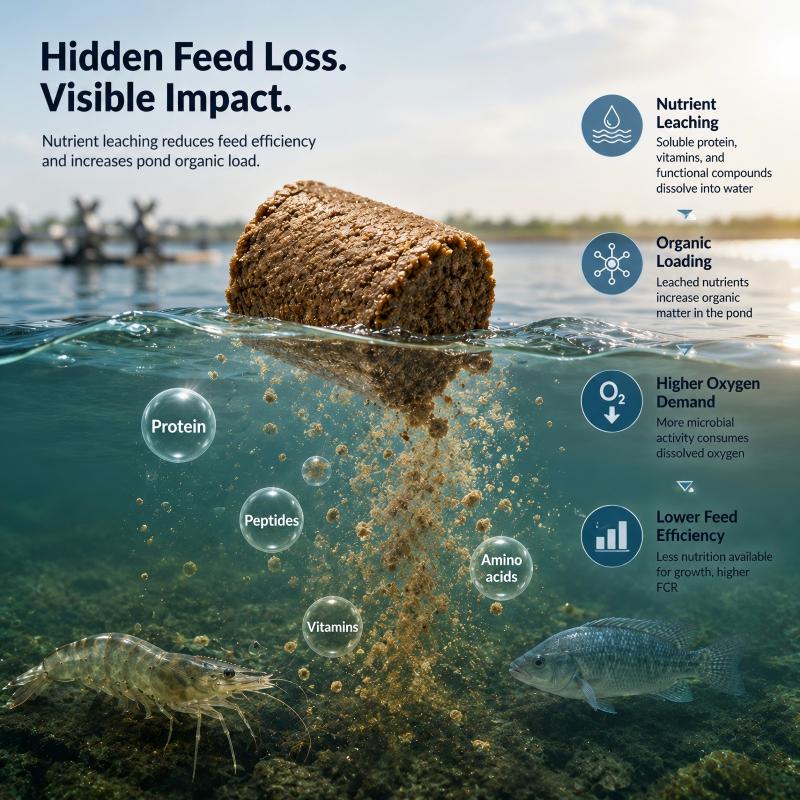
Why Feed Efficiency Can Decline Before Animals Consume the Pellet
Aquaculture feed differs from terrestrial animal feed in one critical way: the pellet enters water before the animal consumes it.
That means the protein, energy, vitamins, and functional ingredients listed on a formulation sheet are not always the same nutrients that reach the fish or shrimp.
Once a pellet enters water, soluble nutrients can migrate into the surrounding environment. Surface fines can detach. Functional compounds can disperse before feeding begins.
The result is straightforward:
Pellet enters water → nutrients migrate into water → less usable nutrition reaches the animal → feed conversion becomes less efficient
Feed efficiency is determined by nutrients consumed, not nutrients declared on the formulation sheet.
When this loss occurs repeatedly, farms may see slower growth, wider biomass variation, and rising FCR even when feed formulation and feeding rates remain unchanged.
Which Nutrients Are Most Vulnerable to Leaching?
Not every nutrient behaves the same way after water exposure.
Water-Soluble Proteins and Small Peptides
Small peptides and water-soluble protein fractions are among the first nutrients to migrate when pellet structure is weak or water penetration is too fast.
This reduces the digestible protein fraction available at the point of ingestion.
For shrimp feed, this can be especially costly because pellets may remain in water longer before bottom-feeding animals consume them.
Vitamins and Functional Compounds
Water-soluble vitamins, nucleotides, small metabolites, and other functional compounds require strong matrix retention.
If they are not sufficiently bound within the pellet structure, they can disperse before reaching the digestive tract.
A pellet may still appear physically intact while its most valuable functional nutrients have already been lost.
Fine Particles and Surface Nutrients
Transport, handling, and storage can generate fines before feed reaches the farm.
Once the pellet enters water, these fine particles detach quickly and increase feed nutrient loss in water.
This creates a hidden problem: visible pellet integrity does not always mean stable nutrient delivery.
Lipid-Coated Ingredients
Lipids do not dissolve as quickly as water-soluble nutrients, but coating quality still affects energy delivery.
Cracks, uneven coating, or poor surface adhesion can reduce energy consistency and expose internal nutrients to water penetration.
How Nutrient Leaching Creates a Double Loss
The first loss occurs inside the feeding program.
When nutrients leach before ingestion, fish and shrimp consume less digestible protein, energy, and functional support than the formulation was designed to provide.
The result is lower nutrient utilization, weaker growth consistency, and poorer aquaculture feed efficiency.
The second loss occurs in the water.
Leached nutrients become dissolved and particulate organic matter. This increases microbial activity, raises biological oxygen demand, and contributes to higher pond loading.
Over time, the production cycle becomes more difficult to control:
Nutrient leaching → lower nutrient intake → weaker feed conversion → higher organic loading → greater oxygen demand → more water-quality stress → further FCR loss
This feedback loop becomes more severe when farms are already managing feed efficiency under water quality stress in aquaculture.
Why Shrimp Feed Requires Stronger Nutrient Retention
Shrimp feed faces a more demanding water-exposure environment than many fish diets.
Shrimp often feed near the pond bottom, and pellets may remain in water during sinking, settling, and repeated feeding activity.
If the pellet loses soluble nutrients before ingestion, the animal receives a lower-quality nutrient package than the original formulation intended.
In shrimp production, nutrient loss before ingestion reduces the usable substrate reaching the hepatopancreas, where digestive enzyme synthesis, nutrient storage, lipid metabolism, and metabolic processing are concentrated.
This is why protein leaching in shrimp feed is not only a pellet-quality issue. It directly affects feed efficiency, biomass uniformity, and pond organic loading.
What Determines Pellet Water Stability?
Pellet water stability is not determined by one factor alone.
It depends on how formulation, grinding, extrusion, binder selection, drying, coating, and handling work together.
| Evaluation Factor | What It Controls | Why It Matters |
|---|---|---|
| Particle integrity | Resistance to cracking and disintegration | Reduces fines and nutrient exposure |
| Binder and matrix structure | Retention of soluble nutrients inside the pellet | Protects nutrient delivery before feeding |
| Extrusion control | Density, expansion, and internal pore structure | Determines water penetration speed |
| Surface coating quality | Energy and functional ingredient retention | Prevents uneven nutrient release |
| Feeding-window match | Stability relative to species feeding behavior | Prevents under-protected or over-engineered pellets |
A pellet does not need to remain unchanged in water for hours.
It needs to remain nutritionally functional during the actual feeding window of the target species.
For this reason, feed pellet stability for shrimp and fish should be evaluated against real water exposure time, feeding behavior, and farm conditions rather than dry-feed appearance alone.
How Functional Fermentation Ingredients Should Be Evaluated
Functional ingredients are often evaluated by label concentration, active compound claims, or laboratory composition.
For aquaculture feed, that is not enough.
Functional fermentation ingredients must also retain their value after extrusion, storage, transport, and water exposure.
The relevant question is not only what a functional ingredient contains, but whether its active metabolites remain associated with the pellet matrix until consumption.
For fermentation-derived yeast culture, key evaluation factors include:
- thermal tolerance during extrusion
- resistance to shear and pellet processing
- water-insoluble fraction control
- matrix binding and nutrient retention
- batch-to-batch manufacturing consistency
This requirement becomes especially important in alternative protein diets in aquaculture, where complex raw-material structures can already increase digestive variability.
Feed Mill Checklist: Reducing Nutrient Loss Before Feeding
Feed mills and aquaculture nutrition teams should evaluate nutrient retention as part of feed-efficiency management.
Key checkpoints include:
- Test nutrient retention after realistic water exposure, not only dry-feed specifications.
- Match pellet stability to species, feeding behavior, and expected water residence time.
- Monitor fines generation after transport, handling, and storage.
- Verify extrusion parameters, binder performance, and coating consistency together.
- Evaluate functional ingredients for thermal tolerance and matrix retention, not label concentration alone.
Improve Nutrient Delivery Before Feed Enters the Pond
Nutrient leaching in aquaculture feed is not only a pellet-quality issue.
It is a feed-efficiency and water-management issue that begins before the animal consumes the diet.
When feed loses nutrients in water, farms face two simultaneous costs: less usable nutrition reaches the animal, while more organic matter enters the production system.
Challenge Group works with feed mills, aquaculture integrators, and distributors to develop fermentation-derived yeast culture solutions designed for processing stability, pellet compatibility, and functional nutrient retention in shrimp and fish feed programs.
Contact our team to discuss formulation compatibility, extrusion performance, and species-specific application support.