
Key Insights
- Environmental stress in aquaculture is one of the most significant hidden drivers of performance variability in modern production systems.
- In fish farming and shrimp farming, environmental challenges often reduce growth efficiency before visible disease symptoms appear.
- Stress-related energy reallocation can impair digestion, nutrient utilization, and feed conversion efficiency.
- Supporting digestive stability and microbial balance may help maintain production resilience during periods of environmental pressure.
Introduction
Modern aquaculture production systems are designed to maximize production efficiency through improved genetics, advanced nutrition, and higher stocking densities. However, as production intensity increases, environmental stability becomes increasingly difficult to maintain.
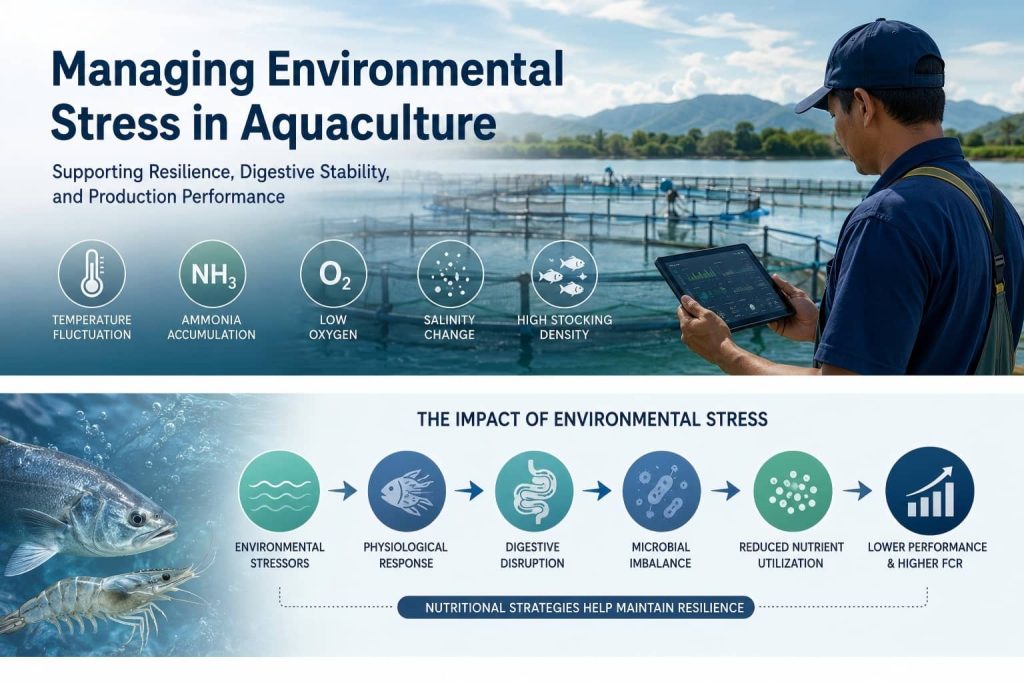
Temperature fluctuations, ammonia accumulation, dissolved oxygen limitations, salinity shifts, and stocking density pressures can all influence the biological performance of fish and shrimp. While these stressors are often associated with disease outbreaks, performance losses frequently begin much earlier.
In many cases, reduced growth rates, inconsistent feed intake, and declining feed conversion efficiency (FCR) occur before any visible pathological signs appear. Understanding how aquatic animals respond to environmental stress factors is therefore essential for maintaining productivity in intensive aquaculture systems.
Common Environmental Stress Factors in Aquaculture Systems
Environmental stress in aquaculture can originate from multiple sources throughout the production cycle. Although the specific challenges vary between species and farming systems, several factors consistently influence biological performance.
| Environmental Factor | Common Cause | Potential Biological Impact |
|---|---|---|
| Temperature Fluctuation | Seasonal changes, weather events | Reduced digestive efficiency and metabolic instability |
| Ammonia Accumulation | Organic waste buildup | Increased physiological maintenance costs |
| Dissolved Oxygen Reduction | Overcrowding, poor aeration | Lower aerobic energy production |
| Salinity Variation | Water exchange, rainfall events | Increased osmoregulatory demand |
| High Stocking Density | Intensive farming systems | Chronic physiological stress |
| Water Quality Instability | Multiple environmental fluctuations | Reduced production consistency |
While these stressors differ in origin, they share a common consequence: increased metabolic demand and reduced energy availability for growth.
How Environmental Stress Reallocates Energy in Aquatic Animals
1. Environmental Stress Is Primarily an Energy Allocation Problem
Environmental stress management in aquaculture is often viewed as a disease-management issue. However, from a physiological perspective, stress first affects how energy is distributed within the animal.
Unlike terrestrial livestock, fish and shrimp are poikilothermic animals whose physiological processes are closely linked to external environmental conditions. When environmental variables shift beyond optimal ranges, animals must allocate additional energy toward maintaining internal stability.
As a result, energy that would normally support tissue growth, protein deposition, and production performance is redirected toward survival functions.
The sequence frequently follows:
Environmental Stress
↓
Metabolic Compensation
↓
Energy Reallocation
↓
Growth Suppression
↓
Increased Disease Susceptibility
For this reason, production performance often declines before visible health problems emerge.
2. Osmoregulation: The Hidden ATP Cost of Salinity Stress
Fish and shrimp continuously exchange ions and water with their surrounding environment. Sudden salinity changes increase the workload of ion transport systems, particularly Na⁺/K⁺-ATPase-dependent pathways located in gill tissues.
To maintain osmotic balance, animals must increase ATP expenditure for ion regulation and cellular homeostasis. This additional energy requirement represents a hidden biological cost that is rarely visible during routine farm inspections.
The energy devoted to osmoregulation is energy that can no longer be invested in tissue accretion, protein synthesis, or biomass gain.
As salinity stress persists, growth efficiency often declines even when mortality remains low.
3. Ammonia Stress and Metabolic Disruption
Ammonia accumulation is commonly associated with water quality deterioration, but its impact extends beyond toxicity.
Elevated ammonia concentrations can disrupt acid-base equilibrium and increase the physiological effort required to maintain internal homeostasis. Additional energy must be allocated to ion transport and detoxification mechanisms.
This shift increases maintenance energy requirements while reducing the proportion of nutrients available for productive functions such as growth and feed conversion.
Consequently, ammonia stress frequently manifests as reduced performance consistency rather than immediate mortality.
4. Thermal Fluctuation and Digestive Enzyme Synchronization
Temperature directly influences enzymatic activity throughout the digestive system.
Rapid thermal fluctuations may disrupt the kinetic synchronization of digestive enzymes, including proteases, lipases, and amylases. When enzyme activity becomes less coordinated, nutrient digestion efficiency declines.
In practical production settings, this often results in incomplete feed utilization, greater nutrient losses, and increased organic waste accumulation.
Even when feed intake appears relatively stable, digestive efficiency may already be compromised.
5. Hypoxia and the Loss of Aerobic Efficiency
Dissolved oxygen is fundamental to ATP production.
Under normal conditions, fish and shrimp rely primarily on aerobic metabolism to generate energy efficiently through oxidative phosphorylation.
When oxygen availability decreases, aerobic ATP production becomes limited. Animals increasingly rely on less efficient anaerobic metabolic pathways, resulting in lower energy yield per unit of nutrient consumed.
The consequence is reduced growth momentum, impaired feed utilization, and increased physiological fatigue.
Environmental Stressor → Metabolic Cost → Production Consequence
Environmental challenges affect production not only through disease risk, but through the metabolic costs they impose on the animal.
| Environmental Stressor | Primary Metabolic Cost | Production-Level Consequence |
|---|---|---|
| Ammonia-N Accumulation | Increased ion transport and acid-base regulation demand | Reduced feed utilization efficiency |
| Thermal Shock | Desynchronization of digestive enzyme activity | Higher nutrient loss and feed wastage |
| Hypoxia | Reduced ATP generation through aerobic metabolism | Slower growth and lower biomass gain |
| Salinity Fluctuation | Elevated osmoregulatory energy expenditure | Increased FCR and size variability |
| High Stocking Density | Increased maintenance energy requirements | Reduced growth uniformity and performance consistency |
This framework helps explain why aquaculture performance often declines before visible disease outbreaks occur.
Why Digestive Stability Becomes Critical During Environmental Stress
Although environmental stress factors cannot always be eliminated, producers can influence how efficiently animals utilize available nutrients under challenging conditions.
As maintenance energy requirements increase, the amount of energy available for growth naturally decreases. Under these circumstances, every unit of digestible nutrient becomes more valuable.
Animals experiencing environmental pressure depend heavily on:
- Stable digestive function
- Efficient nutrient absorption
- Balanced intestinal microbial populations
- Consistent fermentation activity
For this reason, maintaining digestive stability in aquatic species becomes increasingly important during periods of environmental fluctuation. Producers seeking to reduce performance variability often focus on nutritional approaches that help preserve digestive function even when environmental conditions are less than ideal.
Nutritional Strategies for Supporting Production Resilience
Environmental stress management remains the first line of defense against production stress. Maintaining stable water quality, adequate oxygen levels, and appropriate stocking densities should always be prioritized.
However, nutritional strategies for aquaculture stress can also play an important supporting role.
Functional fermentation products, including yeast culture-derived ingredients, provide a variety of biologically active metabolites such as peptides, nucleotides, organic acids, and fermentation compounds that may help support digestive efficiency and microbial balance.
In intensive shrimp farming environments, maintaining gut health in intensive shrimp farming has become an increasingly important component of overall resilience strategies, particularly when environmental variability cannot be fully controlled.
Rather than targeting a single stress factor, these nutritional approaches are often designed to support overall physiological stability throughout the production cycle.
Building More Resilient Aquaculture Production Systems
Environmental stress in aquaculture production systems is an unavoidable reality in modern aquaculture.
Whether the challenge originates from temperature fluctuations, ammonia accumulation, oxygen limitations, or salinity changes, the biological response is often the same: energy is redirected away from growth and toward survival.
Understanding this energy allocation process helps explain why performance losses frequently appear before disease symptoms become visible.
As production systems become increasingly intensive, successful operations will depend not only on controlling environmental variables but also on improving the animal’s ability to maintain digestive efficiency, nutrient utilization, and microbial stability under stress.
For producers evaluating long-term nutritional solutions, yeast culture for aquaculture systems is increasingly being explored as part of broader strategies aimed at supporting digestive stability, gut health, microbial balance, and production resilience in intensive farming environments.