
Executive Summary
- Poor broiler feed conversion ratio (FCR) is commonly linked to inefficient nutrient absorption, intestinal imbalance, and heat stress.
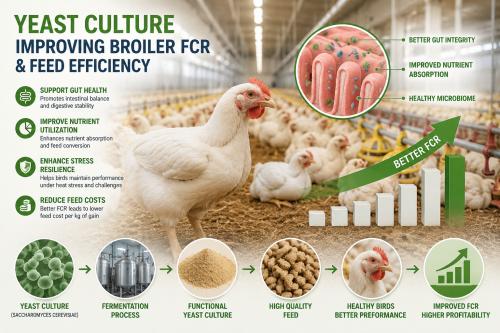
- Yeast culture helps support feed efficiency by improving gut stability, digestive consistency, and nutrient utilization.
- In modern commercial poultry production, even small FCR improvements can significantly reduce overall feed costs.
- Yeast culture is especially valuable in high-density farming, summer production, and antibiotic-free production programs.
Introduction
In modern commercial poultry production, feed costs often account for 65–70% of total production expenses. As raw material prices continue to rise, improving broiler feed conversion ratio (FCR) has become one of the most important goals for poultry producers.
However, poor FCR is not always caused by feed formulation alone. In many broiler operations, inefficient digestion, intestinal stress, and inconsistent feed intake reduce the bird’s ability to utilize nutrients effectively.
During summer production cycles, birds under heat stress frequently reduce feed intake while energy demand increases, causing rapid FCR deterioration in commercial poultry houses.
This is why more nutritionists and feed manufacturers are incorporating yeast culture into broiler diets as part of a long-term feed efficiency strategy.
Unlike simple live yeast products, yeast culture contains functional fermentation metabolites that help support digestive stability and nutrient utilization under practical farming conditions.
For producers looking to improve flock consistency and feed performance, many modern Poultry Solutions programs now include fermentation-based nutritional support.
Why FCR Matters More Than Ever
Improving feed efficiency directly affects profitability.
Even a small improvement in broiler FCR can reduce total feed consumption across large-scale poultry operations. In commercial farming systems, a few FCR points may represent substantial feed savings over an entire production cycle.
Modern broilers are bred for rapid growth, but fast growth rates also increase sensitivity to:
- Heat stress
- Intestinal challenges
- Feed quality fluctuations
- High stocking density
- Environmental stress
Under these conditions, birds may continue consuming feed without fully utilizing nutrients efficiently.
As a result, improving FCR today is not simply about increasing feed intake — it is about improving nutrient absorption and digestive efficiency.
What Causes Poor Broiler FCR?
Poor broiler FCR is commonly caused by inefficient nutrient utilization, intestinal imbalance, and environmental stress.
Inconsistent Feed Digestion
Modern broiler diets contain high levels of energy and protein. If digestion becomes unstable, nutrients may not be fully absorbed.
Common contributing factors include:
- Variable raw material quality
- Digestive stress
- Reduced enzyme activity
- Intestinal irritation
When nutrient utilization declines, birds require more feed to achieve the same growth performance.
Intestinal Stress and Microbial Imbalance
The intestinal environment plays a major role in feed efficiency.
When gut microbial balance becomes unstable, broilers may experience:
- Reduced intestinal integrity
- Lower nutrient absorption
- Increased digestive stress
- Poor litter condition
Supporting intestinal stability has therefore become increasingly important in modern poultry nutrition.
Heat Stress and Reduced Feed Intake
During periods of heat stress, broilers often reduce feed intake while digestive efficiency also declines.
This combination frequently leads to:
- Lower daily gain
- Poor nutrient conversion
- Reduced flock uniformity
- FCR deterioration
Maintaining digestive stability during stress periods is essential for consistent production performance.
How Yeast Culture Supports Better Feed Efficiency
Supporting Gut Stability
Functional compounds produced during fermentation help support a healthier intestinal environment.
A more stable gut environment contributes to:
- Better microbial balance
- Improved digestive consistency
- Reduced intestinal stress
- More efficient nutrient absorption
This becomes especially important in intensive poultry production systems where birds face continuous stress pressure.
Improving Nutrient Utilization
One of the main goals of yeast culture supplementation is improving nutrient utilization efficiency.
Fermentation-derived metabolites may help support:
- Protein utilization
- Energy metabolism
- Digestive activity
- Feed nutrient availability
When digestion becomes more efficient, birds can achieve target growth with lower feed consumption, directly supporting improved feed conversion ratio (FCR).
Supporting Performance During Heat Stress
Stress conditions often reduce feeding consistency in broilers.
Many poultry producers include yeast culture during:
- Summer production
- High-density farming
- Environmental transitions
- Rapid growth stages
Maintaining more stable feed intake helps reduce sudden performance drops and supports better production consistency.
Functional Fermentation Metabolites Matter
A key advantage of yeast culture is that it contains functional fermentation metabolites rather than only yeast cells themselves.
Depending on the fermentation process, products may contain:
- Peptides
- Organic acids
- Enzymes
- Vitamins
- Fermentation metabolites
These compounds help support digestive performance and metabolic activity under practical farming conditions.
For poultry applications requiring fermentation-based nutritional support, products such as Enzyme PLUS – Poultry Use are widely used in commercial feed programs.
Where Yeast Culture Delivers the Best Results
Heat Stress Conditions
High temperatures place significant pressure on broiler metabolism and feed intake stability.
During heat stress periods, maintaining digestive consistency becomes more difficult, especially in high-density poultry houses.
Yeast culture is commonly used to help support digestive stability and reduce production fluctuation during summer feeding programs.
Antibiotic-Free Production Programs
As producers reduce antibiotic usage, maintaining gut stability becomes increasingly important.
Many antibiotic-free production systems include yeast culture as part of broader digestive health and feed efficiency strategies.
High-Energy Diets
High-energy broiler diets place greater demands on digestive performance.
When nutrient digestion becomes inconsistent, FCR deterioration can occur rapidly.
Supporting nutrient utilization becomes especially valuable in these feeding systems.
Choosing the Right Yeast Culture Supplier
Not all yeast culture products provide the same performance.
The effectiveness of a product depends heavily on fermentation quality, metabolite consistency, and manufacturing capability.
When evaluating suppliers, poultry producers should consider:
- Fermentation process stability
- Consistency between production batches
- Stability during feed pelleting
- Technical application support
- Experience in commercial poultry nutrition
Frequently Asked Questions
How does yeast culture improve feed efficiency?
Yeast culture helps improve feed efficiency by supporting gut stability, digestive consistency, and nutrient utilization under commercial farming conditions.
Can yeast culture be used in antibiotic-free poultry production?
Yes. Many antibiotic-free production programs use yeast culture to help maintain intestinal balance and digestive stability without relying on antibiotic growth promoters.
Is yeast culture stable during feed pelleting?
Product stability depends on fermentation quality and manufacturing process. High-quality yeast culture products are typically designed for stability during commercial feed processing and pelleting.
Conclusion
Improving broiler feed conversion ratio (FCR) is not only about increasing feed intake — it is about improving how efficiently birds utilize nutrients under real commercial production conditions.
Digestive stability, nutrient utilization, and stress management all play major roles in feed efficiency performance.
As poultry production systems become more intensive, yeast culture is increasingly used to support consistent growth performance, better nutrient utilization, and more stable flock results.
For feed manufacturers, distributors, and poultry producers seeking practical ways to improve feed efficiency, yeast culture offers a sustainable and commercially applicable nutritional solution.