
Introduction
In layer production, performance is not measured in days—but in consistency over months.
Maintaining stable egg production, shell quality, and bird health across long laying cycles is increasingly challenging under modern conditions, including feed variability, environmental stress, and reduced antibiotic use.
Yeast culture has become an important tool in layer nutrition for addressing these challenges. As a functional additive used across poultry systems, it supports internal stability that directly affects production outcomes.
Why Layer Production Requires Long-Term Stability
Unlike broilers, layer systems demand sustained performance over extended periods:
- Continuous egg production over long cycles
- Sensitivity to nutritional and environmental fluctuations
- Gradual decline in productivity with age
- High importance of eggshell quality and consistency
In this context, short-term performance improvement is less valuable than long-term stability and resilience.
Even small disruptions in gut health or nutrient absorption can lead to:
- Reduced egg production
- Poor shell quality
- Increased variability across the flock
How Yeast Culture Supports Layer Performance
In layer production, yeast culture contributes by maintaining internal balance rather than driving rapid output.
1. Sustaining Nutrient Utilization
Stable digestion supports consistent nutrient availability for egg formation over time.
2. Maintaining Gut Stability
A balanced intestinal environment reduces the risk of long-term performance decline.
3. Supporting Stress Adaptation
Helps birds maintain production levels under environmental or physiological stress.
For a broader understanding of how yeast culture is applied across different poultry systems, refer to Yeast Culture for Poultry.
Key Benefits of Yeast Culture for Layers
From a production standpoint, yeast culture delivers value in areas that directly impact profitability.
1. More Stable Egg Production
Helps reduce fluctuations in laying rate across different stages.
2. Improved Eggshell Quality
Better nutrient utilization supports stronger and more consistent shells.
3. Reduced Performance Decline Over Time
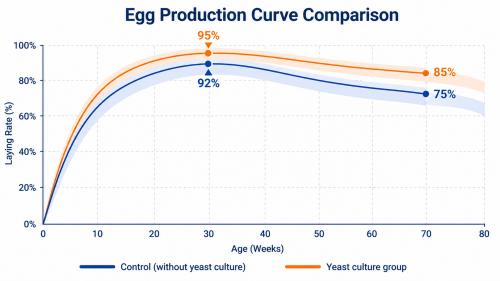
Supports sustained productivity in later laying phases.
In practical applications, field observations often show a more gradual decline in production during late laying stages when yeast culture is consistently included, compared to standard feeding programs.
4. Enhanced Gut Health Stability
A stable digestive system reduces disruptions caused by stress or feed changes.
5. Better Adaptation to Environmental Stress
Supports production consistency during heat stress or management changes.
When to Use Yeast Culture in Layer Production
Timing and consistency of application are critical in layer systems.
1. Early Laying Stage
Supports transition into peak production.
2. Peak Production Phase
Helps maintain high and stable output levels.
3. Late Production Stage
Reduces the rate of performance decline.
4. Stress Conditions
Including heat stress, feed changes, or environmental variation.
In layer production, yeast culture is most effective when used as a long-term stability strategy, rather than a short-term intervention.
Application Strategy in Layer Feed
To maximize results, yeast culture should be integrated into a structured feeding program.
1. Dosage Strategy
Application levels may vary depending on:
- Production stage
- Egg production targets
- Feed formulation
In practice, yeast culture is often applied using a stage-based approach. Higher inclusion levels are typically considered during early laying and peak production to support performance establishment, while a more consistent maintenance level is used during later stages to help sustain stability over time.
2. Compatibility with Other Additives
Yeast culture works well in combination with:
- Enzymes
- Mineral supplements (for shell quality)
- Organic acids
3. Processing Stability
High-quality products maintain functionality during:
- Feed pelleting
- Storage over extended periods
For formulation-compatible solutions, consider Enzyme PLUS – Poultry Use within your feeding system.
Yeast Culture vs Other Additives in Layer Diets
Layer diets often include multiple functional additives.
- Probiotics support microbial balance through live organisms
- Minerals directly affect eggshell formation
- Enzymes improve nutrient availability
Yeast culture works differently—it supports the overall internal environment, enabling these components to perform more consistently.
How to Choose the Right Yeast Culture for Layers
In long-cycle production systems, product consistency is critical.
1. Stable Fermentation Output
Ensures consistent metabolite composition over time.
2. Performance Reliability
Products should deliver stable results across long production cycles.
3. Heat Stability
Maintains effectiveness after feed processing.
4. Application Support
Suppliers should provide guidance tailored to layer production stages.
5. Long-Term Value
Consistency and predictability are more important than short-term performance gains.
Conclusion
Layer production depends on long-term consistency, not short-term gains.
Yeast culture supports this by improving gut stability, maintaining nutrient utilization, and reducing performance fluctuations across the laying cycle.
As production systems move toward greater efficiency and lower tolerance for variability, yeast culture becomes a valuable tool for achieving stable, predictable egg production.
For a complete understanding of how yeast culture fits into overall poultry nutrition strategies, refer to Yeast Culture Solutions for Poultry.
Get Expert Support for Your Layer Feed Strategy
Looking to improve long-term layer performance and egg production stability?
Our yeast culture solutions are designed to support consistent results across the entire laying cycle, with technical support tailored to your feed formulation and production goals.
Contact us to discuss a customized solution for your operation.