
Adding yeast culture to animal feed is not simply a matter of choosing a product and applying a standard inclusion rate. For feed manufacturers, the more important question is how the product fits the feed formulation, production stage, manufacturing process, and existing additive program.
A practical approach starts with the target animal and feed type, then evaluates the yeast culture’s product specifications, inclusion requirements, mixing characteristics, and compatibility with the existing formula. The final inclusion strategy should always follow the technical recommendation for the specific product rather than a universal dosage.
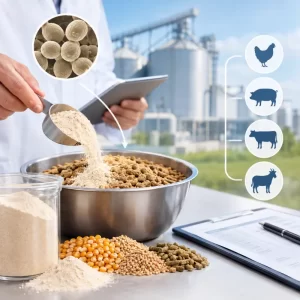
What Should Be Considered Before Adding Yeast Culture to a Feed Formula?
Before incorporating yeast culture in animal feed formulation, feed manufacturers should define where the product fits within the existing feeding program.
Three factors should be considered first:
- Target animal and production stage
- Feed type and formulation objective
- Existing feed ingredients and additives
The purpose is not to add another functional ingredient simply because it has potential benefits. The product should have a defined role within the complete formula.
Target Animal and Production Stage
Yeast culture may be considered in poultry, swine, ruminant, and other animal feed programs, but formulation requirements can differ between species and production stages.
For example, a feed manufacturer may formulate separate diets for broilers, layers, piglets, grower-finisher pigs, dairy cattle, or beef cattle. Each formula has different nutritional priorities and production conditions.
Therefore, the same yeast culture product should not automatically be treated as interchangeable across all feed applications.
For species-specific application considerations, see the existing guides on yeast culture for poultry and yeast culture for ruminants.
Feed Type and Formulation Objective
The next step is to identify the type of feed in which the yeast culture will be incorporated.
Depending on the production system, this may include:
- Complete feed
- Concentrate feed
- Premix
- Mash feed
- Pelleted feed
- TMR or other ruminant feeding systems
The formulation objective also matters. A yeast culture may be considered as part of a broader nutritional strategy, but its role should be defined before determining how it will be incorporated.
This prevents the common mistake of selecting an inclusion level first and trying to justify it afterward.
Match Yeast Culture Specifications With Formulation Requirements
Once the application has been defined, the next step is to evaluate whether the product specification fits the formulation.
This is different from simply asking whether the product is a “good yeast culture.”
Feed manufacturers should review product-specific information such as:
- Product form and handling characteristics
- Guaranteed or declared specifications
- Intended animal application
- Processing and storage requirements
- Relevant nutritional contribution
- Recommended inclusion range
- Technical application guidance
The relationship between product characteristics and consistency is discussed in more detail in Yeast Culture Quality Indicators.
The important point is that a specification should be considered in the context of the intended feed formula. A characteristic that matters for one application may be less important for another.
How to Include Yeast Culture in an Animal Feed Formula
There is no single inclusion rate that applies to every yeast culture product.
Different products can vary in fermentation system, yeast strain, substrate, functional components, product concentration, and intended application. Feed type and animal category can also influence the appropriate formulation strategy.
For this reason, yeast culture inclusion should be determined from the product-specific technical recommendation rather than copied from a general online dosage.
Define the Formulation Objective
Before setting an inclusion level, define what role the yeast culture is expected to play in the formula.
For example, the formulation team may be evaluating the product as part of a strategy related to:
- Digestive support
- Nutrient utilization
- Feed efficiency
- Production-stage nutritional management
- Consistency under practical production conditions
The objective should be specific enough to determine how the product will later be evaluated.
Determine the Product-Specific Inclusion Strategy
The appropriate yeast culture inclusion rate depends on the actual product and application.
Instead of asking:
“What is the standard dosage of yeast culture?”
a feed formulator should ask:
“What inclusion level is recommended for this specific product, animal category, feed type, and formulation objective?”
This distinction is important when comparing products from different suppliers. Two products both described as yeast culture may have different specifications and therefore should not automatically be formulated at the same level.
Consider Premix and Mixing Requirements
After the inclusion strategy has been established, the next consideration is how the yeast culture will be introduced into the feed manufacturing process.
For commercial feed production, consistent distribution is important. A technically suitable product still needs to be incorporated uniformly throughout the finished feed.
Direct Addition or Premix Incorporation
Depending on the production system and inclusion level, a yeast culture may be introduced directly or through an appropriate premix system.
The practical approach depends on:
- Inclusion level
- Product form
- Batch size
- Mixing equipment
- Premix structure
- Existing manufacturing procedures
The objective is to achieve consistent distribution rather than simply adding the correct total quantity to a batch.
Uniform Distribution
Feed manufacturers should also consider the sequence in which the product enters the mixing process.
Small-inclusion ingredients can be more difficult to distribute uniformly than major feed ingredients. A suitable premix or controlled addition procedure may therefore help maintain consistency between batches.
The exact mixing procedure should follow the feed mill’s equipment and the product supplier’s technical instructions rather than a universal procedure.
Can Yeast Culture Be Used With Other Feed Additives?
In many commercial formulas, yeast culture is not the only functional additive being considered.
A feed may also contain enzymes, organic acids, minerals, vitamins, microbial products, or other feed additives. The relevant question is therefore not simply whether yeast culture can be used “with” another additive, but whether the complete combination is appropriate for the specific formulation.
Compatibility should be evaluated according to:
- Product specifications
- Inclusion levels
- Processing conditions
- Storage conditions
- Intended biological or nutritional function
- Supplier technical information
For example, yeast-based products and feed enzymes may have different formulation roles. Yeast-based products are generally evaluated according to their fermentation-derived functional components, while enzymes are typically connected to specific substrates and enzyme activity.
Therefore, combining additives should be based on the formulation objective rather than assuming that adding more functional products will automatically produce a better feed.
How to Evaluate a Feed Formula After Adding Yeast Culture
The formulation process should not end when the yeast culture is added.
Feed manufacturers should evaluate whether the product performs as expected under the actual production conditions.
Check Formula and Manufacturing Consistency
First, confirm that the formula is being manufactured consistently.
Important variables include:
- Ingredient quality
- Mixing consistency
- Feed processing conditions
- Storage
- Feeding management
If several variables change at the same time, it becomes difficult to determine the contribution of the yeast culture.
Monitor Relevant Production Indicators
The appropriate indicators depend on the animal and formulation objective.
Depending on the application, a trial may consider factors such as:
- Feed intake
- Growth performance
- Feed conversion
- Egg production or quality
- Milk production
- General production consistency
These indicators should be selected according to the specific production system rather than using the same evaluation criteria for every animal category.
Compare With the Existing Feeding Program
A useful trial should compare the new formulation with the existing feeding program under reasonably comparable conditions.
Where practical, the evaluation should maintain consistency in:
- Animal category
- Management conditions
- Feed manufacturing
- Feeding period
- Measurement methods
This makes it easier to determine whether observed differences are associated with the formulation change rather than unrelated production variables.
Common Mistakes When Using Yeast Culture in Feed Formulation
Several formulation mistakes can reduce the value of an otherwise suitable yeast culture product.
1. Using a Universal Inclusion Rate
A single dosage should not be assumed to apply to every yeast culture product.
Product specifications and application recommendations should be checked first.
2. Selecting Only by Price per Kilogram
The relevant cost is not simply the purchase price of the product.
Feed manufacturers should consider the required inclusion level, product specification, consistency, and resulting cost per ton of finished feed.
3. Ignoring Product Specifications
The term “yeast culture” alone does not provide enough information to determine formulation suitability.
The product’s declared specifications and intended application should be reviewed before inclusion.
4. Treating Yeast Culture as an Isolated Additive
Yeast culture should be evaluated as part of the complete feed formula.
Its role may depend on the existing ingredients, additives, nutritional structure, processing conditions, and production objective.
5. Changing Several Formulation Variables at Once
If yeast culture, enzymes, organic acids, and other ingredients are changed simultaneously, it becomes difficult to identify which change contributed to the observed result.
A controlled formulation and trial approach provides more useful information.
A Practical Workflow for Adding Yeast Culture to Feed
For feed manufacturers evaluating yeast culture for feed formulation, the process can be summarized as follows:
1. Define the target animal and production stage
Identify the species, production stage, and type of feed being produced.
2. Define the formulation objective
Determine why the yeast culture is being considered and what outcome should be evaluated.
3. Review product specifications
Check the specific product’s declared characteristics, application, handling requirements, and technical information.
4. Check the existing formula
Consider current ingredients, nutritional structure, and other feed additives.
5. Follow product-specific inclusion guidance
Use the supplier’s technical recommendation rather than applying a universal yeast culture dosage.
6. Confirm premix and mixing requirements
Ensure that the selected inclusion strategy can be implemented consistently with the feed mill’s production process.
7. Conduct a controlled trial
Evaluate the formulation under relevant production conditions.
8. Review results and adjust when necessary
Use the trial results to determine whether the yeast culture provides sufficient value for continued use in the formulation.
Why Product-Specific Technical Recommendations Matter
A general guide can explain the principles of using yeast culture in animal feed, but it cannot replace product-specific technical guidance.
Yeast culture products can differ in fermentation system, specifications, functional components, intended application, and recommended inclusion. Feed manufacturing conditions can also vary significantly between feed mills.
For this reason, the most reliable approach is to combine the feed manufacturer’s formulation requirements with the supplier’s product-specific technical information.
For manufacturers evaluating yeast culture for different production systems, the relevant poultry feed solutions, swine feed solutions, and ruminant feed solutions can provide a starting point for matching products with application requirements.
Ultimately, successful yeast culture in animal feed formulation is not about applying one universal formula. It is about selecting a suitable product, defining its role in the complete feed, following product-specific inclusion guidance, incorporating it consistently, and evaluating the finished formulation under practical production conditions.