
Introduction
Modern dairy and beef production systems place increasing pressure on rumen function due to high-concentrate feeding, heat stress, and the demand for improved feed efficiency.
In these conditions, maintaining a stable rumen environment is a core factor for production stability and metabolic health.
Yeast culture is widely used in ruminant nutrition as a fermentation-derived feed additive that supports rumen microbial activity, improves fiber utilization, and stabilizes rumen fermentation under nutritional stress conditions.
Unlike direct nutrient sources, yeast culture functions as a rumen ecosystem regulator, improving how animals utilize both forage and high-energy diets.
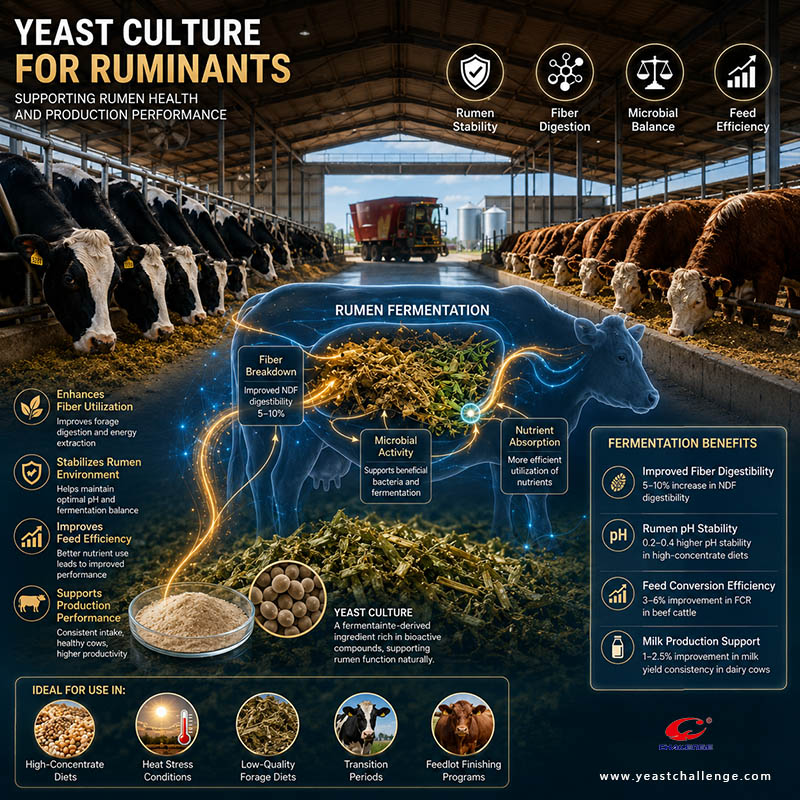
What Is Yeast Culture for Ruminants?
Yeast culture for ruminants is a fermentation-derived feed ingredient produced from Saccharomyces cerevisiae fermentation. It contains yeast cells and bioactive fermentation metabolites such as peptides, organic acids, and B-vitamins.
Its primary function is not microbial colonization, but metabolic modulation of rumen fermentation.
It is widely applied in TMR-based dairy and beef feeding systems, where rumen stability directly affects performance outcomes.
How Yeast Culture Works in the Rumen
Supporting Rumen Microbial Activity and Fermentation Efficiency
The rumen depends on a balanced microbial ecosystem to convert feed into energy through volatile fatty acid production.
Yeast culture enhances microbial activity by providing fermentation-derived nutrients that stimulate cellulolytic bacteria activity and improve overall fermentation consistency.
📊 Field nutrition data suggests improvements in fiber degradation efficiency of approximately 8–12% under low-quality forage conditions, depending on diet composition.
Stabilizing Rumen Fermentation in High-Concentrate Diets
In high-grain feeding systems, rapid starch fermentation can cause acid accumulation and rumen instability.
Yeast culture supports a more stable rumen environment by enhancing microbial balance and reducing pH fluctuations.
📊 Observational feeding data indicates improvements in rumen pH stability of 0.2–0.4 units under intensive feeding conditions.
Improving Fiber Digestion and Forage Utilization
Fiber digestion is a limiting factor in many ruminant production systems, particularly in forage-based diets.
Yeast culture improves the activity of fiber-degrading microorganisms, increasing NDF digestibility by approximately 5–10% in typical dairy and beef feeding systems.
This leads to more efficient energy extraction from roughage-based diets.
Supporting Feed Intake Stability During Stress Conditions
Rumen instability often results in inconsistent feed intake, especially during:
- diet transitions
- environmental heat stress
- high production demand periods
Yeast culture helps maintain a more stable fermentation environment, supporting consistent intake behavior and reducing performance fluctuations.
Applications in Dairy and Beef Production Systems
Optimizing Rumen Stability in High-Yielding Dairy Cows
In modern dairy systems, high-yielding cows experience significant metabolic stress due to energy-dense diets and high lactation demands.
Yeast culture is widely used to support rumen stability during peak production phases, helping maintain consistent digestion and nutrient utilization.
Within dairy nutrition programs, it is commonly associated with improved:
- lactation stability
- feed intake consistency
- rumen fermentation efficiency
Enhancing Milk Production Efficiency Through Rumen Function
Stable rumen fermentation directly supports energy availability for milk synthesis.
Yeast culture contributes to more efficient volatile fatty acid production, improving metabolic energy supply for milk production.
This is closely related to:
- How Yeast Culture Improves Milk Production Efficiency in Dairy Systems
- Yeast Culture and Milk Yield Optimization Strategies
Improving Feed Efficiency in Beef Cattle Production Systems
In feedlot systems, performance depends heavily on efficient conversion of high-energy feed into body weight gain.
Yeast culture supports:
- stable rumen fermentation under high-grain diets
- improved nutrient conversion efficiency
- reduced digestive variability
📊 Feeding trial benchmarks indicate potential improvements of 3–6% in feed conversion efficiency (FCR) in intensive beef finishing systems.
Enhancing Growth Performance in High-Concentrate Feeding Systems
High-energy diets increase fermentation speed and metabolic load in beef cattle.
Yeast culture helps stabilize rumen adaptation, reducing digestive stress and supporting consistent growth performance.
Common Feeding Situations Where Yeast Culture Is Used
| Feeding Situation | Primary Challenge | Functional Role | Expected Outcome |
|---|---|---|---|
| High-Concentrate Diet Systems | Rapid fermentation & acid load | Stabilizes rumen microbial balance | Improved digestion stability |
| Heat Stress Conditions | Reduced intake & metabolic stress | Supports rumen stability | More consistent feed intake |
| Low-Quality Forage Diets | Poor fiber digestibility | Enhances cellulolytic bacteria activity | Higher forage utilization |
| Transition Period (Dairy Cows) | Metabolic instability | Supports rumen adaptation | Smoother dietary transition |
| Feedlot Finishing Systems | High-energy metabolic load | Improves fermentation efficiency | Better feed conversion |
Yeast Culture vs Live Yeast in Ruminant Nutrition
Although often used together in feed formulations, yeast culture and live yeast function differently.
- Live yeast acts through metabolic activity and oxygen scavenging in the rumen
- Yeast culture functions through fermentation metabolites and bioactive compounds
In industrial feed systems, yeast culture is often preferred due to:
- higher thermal stability
- consistent composition
- compatibility with TMR and pelleting processes
Practical Feeding Considerations for Ruminant Diets
The effectiveness of yeast culture depends on its integration into the overall nutrition system rather than standalone use.
Key influencing factors include:
- forage quality
- concentrate ratio
- production stage
- environmental stress
- ration formulation balance
Choosing a Yeast Culture Product for Ruminants
Pelleting Stability and Industrial Processing Resistance
For commercial feed manufacturers, processing stability is a critical procurement requirement.
High-quality yeast culture products are designed to maintain functional integrity during feed processing, including pelleting, mixing, and storage.
📊 Industrial benchmark data shows that advanced formulations can withstand pelleting temperatures of 85°C–90°C without significant loss of fermentation-derived bioactivity.
This makes them suitable for large-scale feed mill operations where thermal processing is unavoidable.
Functional Composition and Application Design
Product performance depends on fermentation-derived metabolite profiles, including peptides, organic acids, and micronutrient compounds.
System-Specific Formulation Strategy
Different formulations may be optimized for dairy cows, beef cattle, or high-concentrate feeding systems.
Advanced Mechanism View
Yeast culture functions through three core biological pathways in ruminants:
1. Microbial Activation Pathway
Stimulates cellulolytic bacterial activity → improves fiber breakdown efficiency
2. Fermentation Stabilization Pathway
Reduces rumen pH fluctuation → supports stable VFA production
3. Nutrient Utilization Pathway
Enhances feed conversion efficiency → improves energy availability
Key Mechanism Summary Table
| Mechanism | Biological Target | Functional Outcome |
|---|---|---|
| Microbial Activation | Cellulolytic bacteria | Improved fiber digestion |
| Fermentation Stability | Rumen pH balance | Stable rumen environment |
| Nutrient Utilization | VFA production system | Higher feed efficiency |
Conclusion
Yeast culture for ruminants is a fermentation-derived feed additive designed to support rumen microbial balance, improve fiber digestion, and enhance feed efficiency in modern dairy and beef production systems.
Its value is most significant in high-performance production environments where animals are exposed to nutritional, metabolic, or environmental stress.
Rather than acting as a nutrient source, yeast culture functions as a rumen ecosystem stabilizer, improving long-term digestion efficiency and production consistency.
As part of modern ruminant nutrition strategies, it plays an important role in improving productivity, feed utilization, and metabolic stability in both dairy and beef systems.