Key Insights
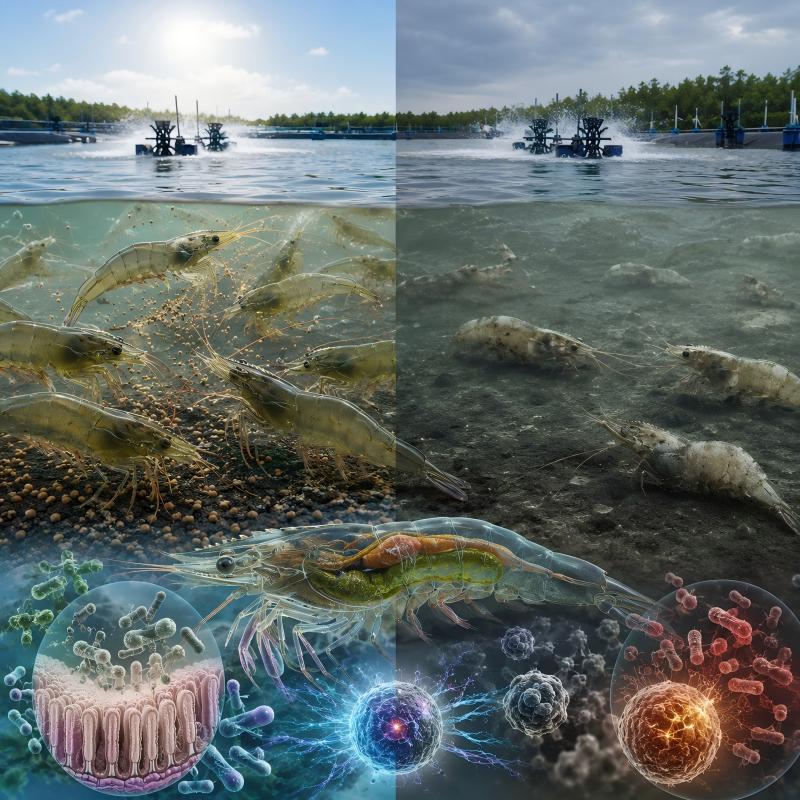
- Vibrio pressure in shrimp farming systems disrupts gut integrity, immune balance, and feeding behavior, directly affecting production stability.
- Yeast culture does not function as an antimicrobial agent; instead, it supports physiological resilience under pathogen stress conditions.
- Key response pathways include intestinal barrier reinforcement, antioxidant defense activation, microbial balance stabilization, and feeding recovery support.
- Production outcomes depend on the interaction between nutrition, environment, and baseline farm conditions, rather than any single input.
Why Vibrio Pressure Remains a Critical Challenge in Shrimp Farming
In intensive aquaculture systems, Vibrio pressure in shrimp production is a persistent biological constraint rather than an occasional event.
Vibrio species exist naturally in aquatic environments. When environmental stability declines—such as oxygen fluctuations, organic matter accumulation, or temperature variation—opportunistic proliferation can occur, increasing disease risk.
Typical production consequences include:
- Reduced feed intake
- Increased mortality risk
- Slower post-stress recovery
- Decline in growth uniformity
As highlighted in environmental stress in aquaculture systems, microbial dynamics are strongly influenced by water quality stability, stocking density, and operational consistency.
How Vibrio Pressure Affects Shrimp Physiology
Vibrio exposure does not act through a single pathway. Instead, it triggers multiple physiological disruptions:
1. Intestinal Barrier Damage
Vibrio toxins can impair epithelial integrity, reducing nutrient absorption efficiency and weakening gut defense systems.
2. Immune System Activation
Shrimp rely on innate immunity. Under pathogen stress, immune resources are rapidly mobilized, increasing metabolic energy demand.
3. Oxidative Stress Accumulation
Pathogen challenge leads to excessive reactive oxygen species (ROS), resulting in oxidative imbalance.
4. Feeding Behavior Suppression
One of the earliest field indicators is reduced feed intake, which directly impacts growth recovery and FCR stability.
Vibrio Response Mechanism Matrix
The following matrix summarizes how yeast culture supports shrimp under Vibrio pressure from a mechanistic and field-performance perspective.
| Pathogenic Challenge | Yeast Culture Defense Mechanism | Key Biomarkers (Physiological) | Field Performance Indicators |
|---|---|---|---|
| Vibrio cytotoxin damage | Intestinal epithelial integrity support & mucosal regeneration | Midgut epithelial height ↑ Microvilli density ↑ Epithelial shedding ↓ |
Improved gut fullness Lower empty gut incidence More stable digestion under stress |
| Oxidative stress / ROS surge | Activation of endogenous antioxidant defense system | Superoxide Dismutase (SOD) ↑ Catalase (CAT) ↑ Glutathione Peroxidase (GSH-Px) ↑ |
Faster post-stress recovery Reduced hepatopancreas discoloration Improved survival stability |
| Pathogen overgrowth pressure | Gut microbial ecosystem stabilization | Increased beneficial bacteria ratio Reduced Vibrio dominance Improved microbial diversity |
Lower outbreak frequency More stable gut microbial balance |
| Stress-induced anorexia | Feeding recovery and digestive stimulation support | Improved digestive enzyme activity Stable gut motility signals |
Faster feed intake recovery Improved FCR stability after stress |
Field Interpretation
Biomarkers reflect physiological response, while field indicators determine commercial production success.
In commercial shrimp farming systems, improved outcomes are observed when:
- Gut integrity stabilizes
- Feeding recovery accelerates
- Survival rate variability decreases
This confirms that nutritional interventions act as resilience enhancers rather than disease control agents.
Where Nutritional Support Fits in Vibrio Management
A common misunderstanding in aquaculture practice is expecting feed additives to directly control pathogenic bacteria.
In reality:
Nutrition does not replace biosecurity or environmental control. It enhances physiological resilience under stress conditions.
Effective Vibrio management requires integration of:
- Water quality management
- Biosecurity control systems
- Feeding strategy consistency
- Nutritional support programs
As discussed in why similar nutrition programs produce different results between aquaculture farms, baseline system conditions strongly influence biological response magnitude.
Integrating Yeast Culture Into Shrimp Production Systems
Yeast culture contributes to system stability through multiple interconnected pathways:
- Gut barrier reinforcement improves nutrient utilization efficiency
- Antioxidant support enhances stress tolerance capacity
- Microbial stabilization reduces opportunistic pathogen dominance
- Feeding recovery support improves production consistency
These effects are most visible during periods of environmental or microbial stress, when physiological demand increases.
What Should Producers Monitor Under Vibrio Pressure?
Instead of focusing solely on survival or final harvest weight, a more accurate evaluation framework includes:
- Feed intake recovery speed
- Survival stability across production cycles
- FCR consistency under stress conditions
- Gut condition and hepatopancreas appearance
- Behavioral uniformity after stress events
These indicators better reflect system resilience rather than short-term growth response.
Production Insight: Why Responses Differ Between Farms
Even under similar Vibrio challenge conditions, performance outcomes vary significantly across farms.
This variability is driven by:
- Baseline environmental stability
- Pre-existing animal health status
- Feeding and management consistency
- Microbial ecosystem structure
This explains why field responses often differ across regions, seasons, and production systems—even when identical nutritional programs are used.
Conclusion
Vibrio pressure in shrimp farming systems represents a complex interaction between environmental conditions and biological responses.
Yeast culture supports shrimp resilience by reinforcing:
- Intestinal integrity
- Antioxidant defense systems
- Microbial balance stability
- Feeding recovery capacity
However, its effectiveness depends on the overall production system, including water quality, management consistency, and baseline farm conditions.
In modern aquaculture production, the most stable outcomes are achieved not by eliminating stress entirely, but by improving the system’s ability to maintain physiological and production stability under stress conditions.