
Key Insights
- Weaning is one of the most stressful stages in piglet production and often leads to reduced feed intake and digestive instability.
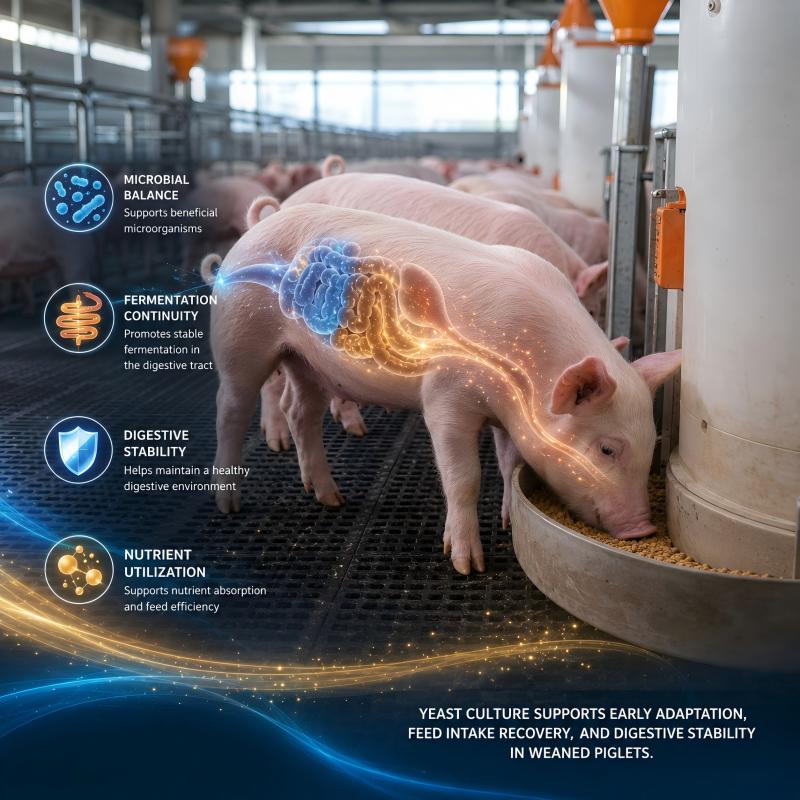
- Yeast culture supplementation helps support microbial balance and fermentation continuity during feed transition periods.
- Field nutrition reports suggest yeast culture may contribute to more consistent feed intake and improved feed efficiency in starter pig programs.
- Industrial-grade yeast culture products designed for 85–90°C pelleting conditions help maintain functionality in commercial feed manufacturing.
Introduction
Modern piglet production systems place significant pressure on animals during the weaning period. Feed changes, environmental stress, transportation, and group mixing can all disrupt digestive stability and reduce feed intake immediately after weaning.
For commercial producers, the biggest concern is often not short-term growth performance, but how quickly piglets adapt to starter diets and return to consistent feed consumption. Delayed adaptation frequently leads to growth lag, uneven batches, and higher production costs.
As a result, many nutrition programs now focus on supporting early digestive adaptation and maintaining more stable fermentation patterns during the transition period. Yeast culture for piglets is increasingly used in starter feed programs because it provides fermentation metabolites and functional compounds that support microbial balance, digestive consistency, and feed intake recovery after weaning, particularly in feeding strategies focused on long-term fermentation continuity and commercial swine feed efficiency.
Why Weaning Is a High-Risk Stage for Piglets
The weaning stage creates several simultaneous challenges for piglets:
- Sudden transition from milk to solid feed
- Changes in environment and social grouping
- Digestive microbial disruption
- Reduced appetite and lower feed intake
In newly weaned piglets, the digestive system is still developing. During this period, even short interruptions in feed intake may reduce nutrient utilization and slow down growth performance.
In commercial production systems, this often becomes an economic issue rather than simply a nutritional issue. Piglets that fail to adapt quickly after weaning may show:
- Lower daily weight gain
- Greater performance variation
- Reduced feed efficiency
- Higher management pressure
For this reason, improving adaptation speed and maintaining digestive stability have become key priorities in modern starter pig nutrition programs.
How Yeast Culture Supports Early Adaptation in Piglets
Supporting Feed Intake Recovery After Weaning
One of the biggest post-weaning challenges is reduced appetite. Newly weaned piglets often experience a temporary drop in feed intake while adapting to new diets and production environments.
Yeast culture supplementation is increasingly used to support smoother adaptation during this period. Fermentation metabolites and bioactive compounds may help maintain digestive comfort and encourage more consistent feeding behavior.
Field nutrition observations suggest yeast culture may contribute to:
- Faster feed intake recovery after weaning
- Reduced growth lag during transition periods
- More stable starter feed consumption
- Improved feeding consistency under stress conditions
This becomes especially important in regions with high environmental temperatures, where heat stress in weaned piglets may further reduce feed intake and digestive stability.
Rather than focusing only on maximum growth rate, many commercial feeding programs now prioritize maintaining steady intake patterns and reducing performance fluctuation during early-life nutrition stages.
Supporting Digestive Stability During Feed Transition
Feed transition is one of the most sensitive periods for piglet digestion. Sudden dietary changes can affect microbial balance and intestinal stability, particularly in intensive production systems.
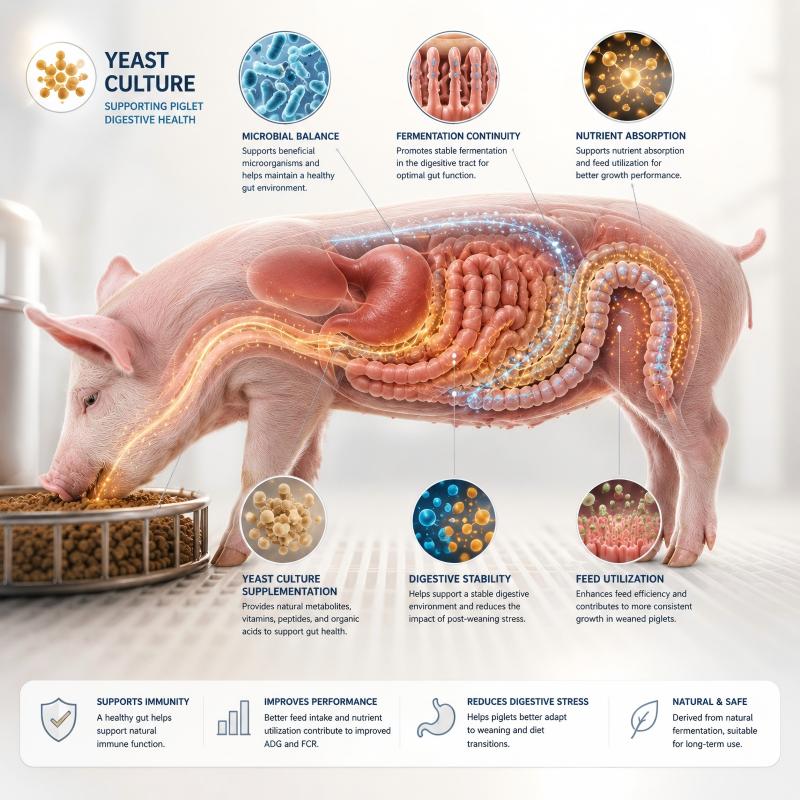
Yeast culture contains fermentation-derived metabolites, peptides, enzymes, and organic compounds that help support a more stable digestive environment.
In practical feeding applications, this may contribute to:
- Better microbial balance
- More stable intestinal fermentation
- Improved nutrient utilization
- Reduced digestive fluctuation during feed transition
Because digestive consistency is closely connected to feed efficiency, maintaining a balanced gut environment is increasingly viewed as an important part of commercial piglet nutrition management.
Specialized products such as Enzyme PLUS – Swine Use are increasingly integrated into modern starter pig nutrition programs designed to support digestive consistency during feed transition periods.
Why Fermentation Continuity Matters in Starter Pig Nutrition
Large-scale pig production systems increasingly focus on maintaining fermentation continuity — stable and predictable digestive activity throughout feeding cycles.
Inconsistent fermentation patterns may lead to:
- Uneven feed utilization
- Performance fluctuation between groups
- Lower feeding predictability
- Reduced operational efficiency
Yeast culture supplementation is commonly integrated into feeding programs designed to support more continuous digestive activity and more stable nutrient utilization. In modern Swine Solutions focused on large-scale commercial production, reducing variability is often just as important as improving peak performance. Stable digestion, predictable feed intake, and smoother adaptation help improve overall production consistency across starter pig operations.
Problem → Mechanism → Outcome
| Problem | Mechanism | Outcome |
|---|---|---|
| Reduced feed intake after weaning | Fermentation metabolites support digestive adaptation | Faster feed intake recovery |
| Digestive instability during feed transition | Supports microbial balance and gut environment | More stable digestion and nutrient utilization |
| Performance fluctuation in starter pigs | Helps maintain fermentation continuity | More predictable growth performance |
Why Pelleting Stability Matters in Commercial Piglet Feed
In commercial feed manufacturing, pelleting temperatures commonly reach 85–90°C. Under these conditions, some biological feed additives may lose activity or become less stable.
This is particularly important in regions where feed mill equipment operates under inconsistent temperature control or high-intensity pelleting conditions.
Compared with highly temperature-sensitive live microbial products, yeast culture products containing fermentation metabolites are often considered more compatible with commercial pelleting processes.
For feed manufacturers and distributors, pelleting stability helps support:
- More reliable feed production
- Better batch consistency
- Reduced ingredient performance risk
- More predictable functionality after processing
In large-scale operations, ingredient stability during manufacturing is an important part of maintaining feeding consistency at the farm level.
Yeast Culture vs Probiotics: What’s the Difference?
Many buyers confuse yeast culture with probiotics or live yeast products, but they function differently in animal nutrition programs.
| Feature | Yeast Culture | Probiotics / Live Yeast |
|---|---|---|
| Main Function | Fermentation support and metabolites | Live microbial activity |
| Contains Fermentation Metabolites | Yes | Limited |
| Heat Stability During Pelleting | Generally higher | More temperature-sensitive |
| Focus | Digestive stability and fermentation continuity | Delivering live organisms |
| Commercial Feed Compatibility | Strong | Depends on processing conditions |
In commercial piglet feed programs, yeast culture is often selected because it combines digestive support with stronger manufacturing compatibility under practical feed processing conditions.
FAQ
Can yeast culture help newly weaned piglets?
Yes. Yeast culture is commonly used in starter pig nutrition programs to support feed intake recovery, microbial balance, and digestive stability during the weaning transition period.
Can yeast culture survive feed pelleting?
Industrial-grade yeast culture products designed for commercial feed manufacturing are commonly used under pelleting temperatures of approximately 85–90°C.
Is yeast culture the same as probiotics?
No. Probiotics mainly focus on delivering live microorganisms, while yeast culture primarily provides fermentation metabolites and functional compounds that support digestive stability and nutrient utilization.
Conclusion
Weaning remains one of the most challenging stages in commercial pig production because digestive instability and reduced feed intake can quickly affect growth performance and operational consistency.
Modern nutrition programs increasingly focus on supporting early adaptation, stable fermentation patterns, and predictable feed intake recovery during this period.
Yeast culture for piglets is widely used as part of these strategies because it helps support microbial balance, digestive stability, and fermentation continuity under practical commercial feeding conditions.
For producers seeking more stable starter pig performance and improved feeding consistency, yeast culture supplementation has become an increasingly valuable tool in modern piglet nutrition programs.