
Introduction
Broiler production today is built on efficiency. With rapid growth cycles, high stocking density, and increasing pressure to reduce antibiotics, even small fluctuations in feed performance can significantly impact profitability.
Under these conditions, the challenge is not just maximizing growth—but maintaining consistent, predictable performance across different batches and environments.
Yeast culture has become a widely used solution in broiler nutrition for exactly this reason. Rather than acting as a single-function additive, it helps stabilize the internal conditions that determine feed efficiency and growth outcomes.
Why Broiler Production Needs More Stable Feed Additives
Modern broiler systems operate under tight margins and high biological pressure:
- Rapid growth rates increase metabolic demand
- High-density housing raises stress levels
- Feed quality may vary between batches
- Environmental factors (especially heat stress) affect performance
In such systems, performance loss is often not caused by a single factor, but by instability within the production system.
This is where yeast culture plays a role—not by forcing higher output, but by helping reduce fluctuations in feed utilization and gut function.
How Yeast Culture Supports Broiler Performance
In broiler production, the value of yeast culture is best understood through its impact on key performance drivers.
1. Feed Efficiency Optimization
By supporting a more stable digestive environment, yeast culture helps birds utilize nutrients more effectively, leading to improved feed conversion outcomes.
2. More Consistent Growth
Instead of pushing peak growth, it helps maintain uniform development across the flock, reducing variation between individuals.
3. Better Adaptation to Stress
Under conditions such as heat stress, feed transition, or transport, yeast culture supports physiological stability, helping birds maintain performance levels.
These effects are closely linked to the way yeast-derived components interact with gut function, as explained in How Yeast Culture Works in the Animal Gut Environment.
Key Benefits of Yeast Culture for Broilers
From a practical production perspective, yeast culture delivers measurable advantages:
1. Improved Feed Conversion Ratio (FCR)
More efficient nutrient use directly translates into lower feed cost per unit of gain.
2. Better Daily Weight Gain
Growth performance becomes more stable, especially under non-ideal conditions.
3. Reduced Performance Variability
Flocks show more uniform growth, which is critical for processing and market consistency.
4. Stronger Gut Stability Under Stress
A more balanced intestinal environment helps reduce the negative impact of environmental and nutritional challenges.
When to Use Yeast Culture in Broiler Production
Application timing is critical for maximizing results. Yeast culture is particularly effective during:
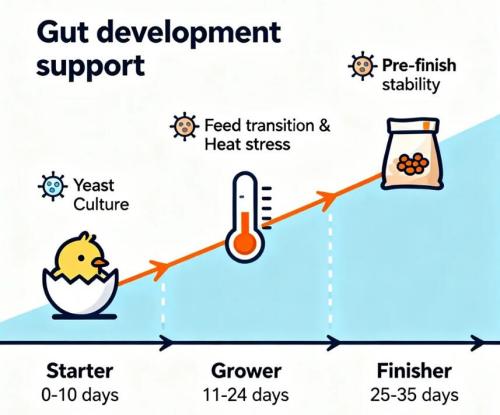
1. Early Growth Stage
Supports gut development and early feed adaptation.
2. Feed Transition Periods
Helps birds adjust when switching feed formulations.
3. Heat Stress Conditions
Improves tolerance to high temperatures and reduces performance drops.
4. High-Density Production
Supports stability in more intensive farming systems.
In practice, yeast culture is most valuable when the goal is to reduce risk and maintain consistency, rather than simply boost peak performance.
Application Strategy in Broiler Feed
To achieve consistent results, yeast culture should be integrated into the overall feed formulation strategy.
1. Dosage Approach
Inclusion levels should be adjusted based on:
- Growth stage
- Feed formulation complexity
- Production goals
A fixed dosage is less effective than a stage-based strategy.
2. Combination with Other Additives
Yeast culture works well alongside:
- Enzymes (to improve nutrient breakdown)
- Organic acids (to support gut environment)
This allows for a more balanced and functional feed system.
3. Processing Stability
High-quality yeast culture products maintain functionality during:
- High-temperature pelleting
- Storage and transport
This ensures consistent performance in industrial feed production.
For formulation-compatible solutions, consider Enzyme PLUS – Poultry Use within your feed program.
Yeast Culture vs Other Additives in Broiler Diets
In broiler nutrition, yeast culture is often evaluated alongside other additive types.
- Probiotics focus on introducing live beneficial microorganisms
- Enzymes target specific nutrient breakdown
Yeast culture, by contrast, works at the system level, helping create a more stable internal environment for digestion and growth.
Rather than replacing other additives, it is commonly used as a complementary tool to improve overall system efficiency.
How to Choose the Right Yeast Culture for Broilers
Not all yeast culture products perform equally in broiler systems. Key selection factors include:
1. Fermentation Consistency
Stable production processes ensure reliable metabolite profiles.
2. Heat Resistance
The product must maintain activity after pelleting.
3. Application Fit
Solutions should be adaptable to broiler-specific production stages and goals.
4. Performance Stability
Consistent results across different batches and environments are more valuable than short-term gains.
5. Technical Support
Suppliers should provide formulation guidance and practical application support.
Conclusion
In broiler production, efficiency is not just about maximizing growth—it is about maintaining stable, repeatable performance under real-world conditions.
Yeast culture supports this goal by improving feed efficiency, reducing variability, and helping birds adapt to stress. As production systems become more intensive and less tolerant of fluctuation, yeast culture is increasingly valued as a stability-driven solution, rather than a short-term performance enhancer.
For a broader perspective on yeast culture applications across different poultry systems, refer to Yeast Culture for Poultry.