
Introduction
In commercial animal production, few situations are more frustrating than this:
you add a yeast culture to the diet, follow the recommended inclusion rate, track performance carefully—yet feed conversion ratio (FCR) shows little or no improvement.
This often leads to a quick conclusion: “Yeast culture doesn’t work in my system.”
However, field experience suggests that this conclusion is frequently incomplete.
This article systematically examines five commonly overlooked technical blind spots and explains why, under certain production conditions, an unchanged FCR may not indicate failure—but rather an early sign of system-level correction.
The objective is to help you evaluate yeast culture supplementation based on how production systems actually respond, not on simplified expectations.
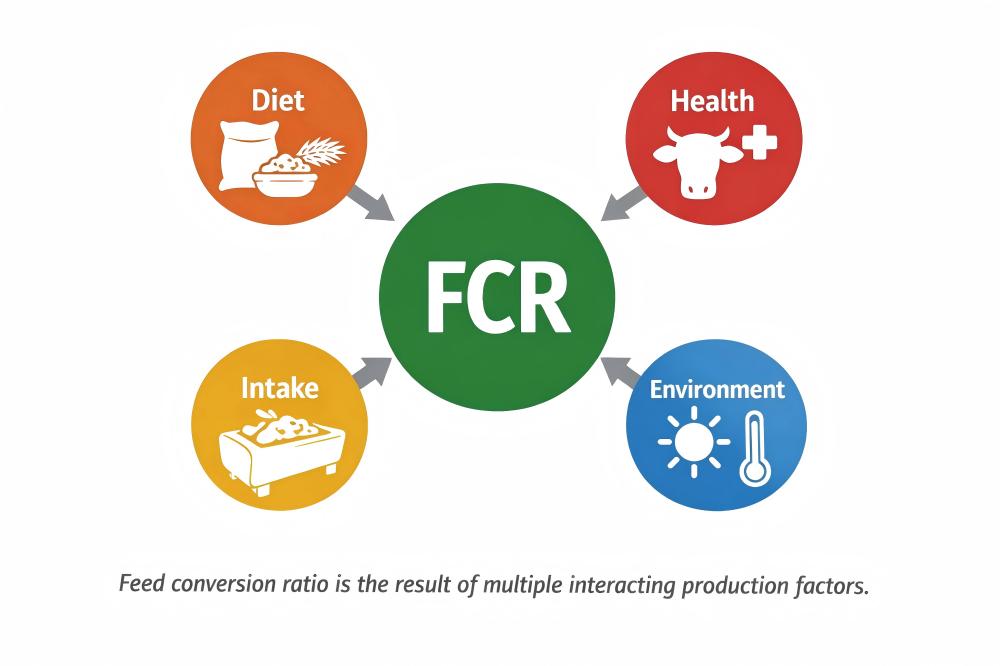
Feed Conversion Ratio Is Influenced by More Than One Variable
FCR is a cumulative outcome, not a single-response metric.
It reflects the combined influence of:
-
Baseline diet digestibility
-
Feed intake consistency and losses
-
Animal health status
-
Environmental and management stress
-
Production stage and genetic ceiling
Industry observations consistently show that no single feed additive can shift FCR in isolation. Yeast culture functions within this system—it supports specific biological processes, but it does not override limitations elsewhere.
Yeast Culture Improves Digestive Efficiency — Not Feed Intake Control
Yeast culture is primarily associated with:
-
Stabilizing rumen or intestinal microbial environments
-
Supporting fiber degradation and nutrient availability
-
Reducing fermentation instability under stress
What it does not directly regulate:
-
Overfeeding or underfeeding
-
Feed sorting and wastage
-
Intake suppression caused by heat stress or water access issues
Field cases often show that yeast culture improves nutrient utilization efficiency, while intake-related inefficiencies continue to dominate the FCR equation. In such situations, biological improvement may occur without an immediate numerical change in FCR.
Common Reasons FCR Does Not Improve After Yeast Culture Supplementation
•Baseline Diet Limits the Response
Yeast culture acts as a biological amplifier, not a nutritional repair tool.
If the basal diet is constrained by low fiber digestibility, inconsistent forage quality, or imbalanced energy density, the scope for FCR improvement is limited. A useful way to understand this is:
A yeast culture functions like a highly skilled coach—it can help maximize existing potential, but it cannot transform an underprepared system into a high-performing one overnight. The basal diet defines that foundation.
Many field applications show that under such conditions, yeast culture stabilizes digestion without producing a visible FCR shift.
•Application Rate Is Too Conservative for Measurable Change
Another frequently overlooked factor is dose–response visibility, not product inefficacy.
Industry observations and on-farm trials suggest a simplified response pattern:
-
Below the response threshold: biological effects are present but difficult to measure
-
Near the threshold: responses fluctuate and lack repeatability
-
Within the effective range: responses become stable and detectable
When inclusion rates are set conservatively—often to minimize cost—the response may remain below the detection limit of FCR, even though rumen or gut conditions are improving.
•Short Observation Period Masks Real Effects
FCR is highly sensitive to short-term disruptions, including:
-
Diet transitions
-
Weather-related stress
-
Health challenges
-
Intake variability
Field experience across commercial farms shows that early benefits of yeast culture often appear as improved stability rather than immediate efficiency gains. Short evaluation windows may therefore underestimate its contribution.
This is why unchanged FCR values in early stages do not necessarily indicate a lack of biological response.
•Health and Environmental Stress Override Nutritional Gains
Subclinical health issues, heat stress, overcrowding, or inconsistent water access can easily neutralize nutritional improvements.
In many documented cases, yeast culture plays a protective role, helping prevent further efficiency loss rather than producing visible gains. Nutritional tools alone cannot fully compensate for management-driven stressors.
•Incorrect Expectation: FCR Is Not Always the First Parameter to Respond
One of the most common evaluation errors is assuming that FCR should respond first.
Practical feeding experience indicates a typical response priority sequence:
First to improve:
-
Fecal consistency
-
Feed intake stability
Then:
-
More consistent daily gain or milk output
-
Fewer health-related performance disruptions
Finally:
-
Long-term FCR optimization
-
Overall feed cost efficiency
When FCR is treated as the sole success indicator, earlier and meaningful system corrections are often overlooked.
•Product Selection Mismatch with Production Objective
Not all yeast culture products are designed for the same biological role.
For example, in high-producing lactating dairy cow diets where fiber degradation and rumen stability are primary objectives, using a general-purpose yeast culture originally designed for monogastric intestinal health may lead to limited FCR response. The biological pathway exists—but it is indirect and therefore less visible at the efficiency level.
Differences in strain selection, fermentation substrates, and production processes determine where and how a yeast culture performs. This mismatch between product design and production goal is a common reason for underwhelming results.
A deeper explanation of these differences is available in Why Some Yeast-Based Feed Additives Work Better Than Others.
When Yeast Culture Improves Performance Without Changing FCR
Many commercial operations report scenarios where yeast culture delivers value without immediate FCR reduction, including:
-
Improved intake consistency during stress periods
-
Reduced digestive disturbances
-
More stable production output across batches
These outcomes frequently translate into lower hidden costs, even when FCR remains numerically unchanged in the short term.
How to Evaluate Yeast Culture Performance More Accurately
A more reliable evaluation approach typically includes:
-
Comparing against a stable baseline period
-
Monitoring digestive and intake indicators alongside FCR
-
Allowing sufficient time for system-level adjustment
-
Ensuring product design matches the production objective
For economic interpretation, see Is Yeast Culture Worth the Cost in Commercial Animal Production?
Practical Product Alignment and Technical Support
Effective yeast culture programs typically combine:
-
A strain-appropriate yeast culture aligned with species and production stage
-
Consistent inclusion within a nutritionally balanced ration
-
Technical guidance based on real feeding conditions
Solutions such as Saccharomyces-based brewing yeast culture formulations and ruminant-specific yeast culture products are developed to support digestive stability under commercial—not idealized—conditions.
When results fall short of expectations, the fastest improvement often comes from technical recalibration, not from abandoning supplementation entirely.
Conclusion
When FCR does not respond as expected, the most productive next step is often not changing the additive—but clarifying where the limitation actually lies.
In many cases, a short technical review of the basal diet, inclusion strategy, and yeast culture selection is enough to determine whether the constraint is nutritional, managerial, or product-related.
If you are currently evaluating yeast culture performance or questioning whether your current approach aligns with your production objectives, you may consider contacting our technical team for a structured discussion based on real feeding conditions rather than assumptions.
FAQ of Yeast Culture and Feed Conversion Ratio
- Q1: Does yeast culture always improve feed conversion ratio?
A: No. Yeast culture supports digestive efficiency and microbial stability, but FCR is influenced by diet quality, intake consistency, health status, and management factors. Under certain conditions, FCR may remain unchanged even when biological responses occur. - Q2: How long should yeast culture be used before evaluating FCR results?
A: Short observation periods can mask real effects. Field experience shows that digestive stability and intake consistency often improve before measurable changes in long-term FCR become visible. - Q3: Can an incorrect yeast culture product limit FCR improvement?
A: Yes. Yeast culture products are designed for different biological roles. A mismatch between product design and production objectives can result in limited or indirect effects on FCR. - Q4: What indicators should be monitored besides FCR?
A: Fecal consistency, feed intake stability, production consistency, and health-related disruptions are often earlier indicators of yeast culture response than FCR alone. - Q5: Does increasing the dosage always improve FCR results?
A: Not necessarily. While very low inclusion rates may fall below the response threshold, optimal results depend on balanced formulation, correct product selection, and overall feeding strategy rather than dosage alone.