
Why Understanding the Fermentation Process Matters
Fermentation-based feed additives are widely used in modern livestock production, but not all products deliver consistent results. Two products may look similar on a specification sheet, yet perform very differently in the field.
The key difference often lies not in the label, but in how the product is made.
Understanding the fermentation process—from raw materials to final stabilization—helps buyers evaluate product quality more accurately and avoid performance risks caused by inconsistent manufacturing.
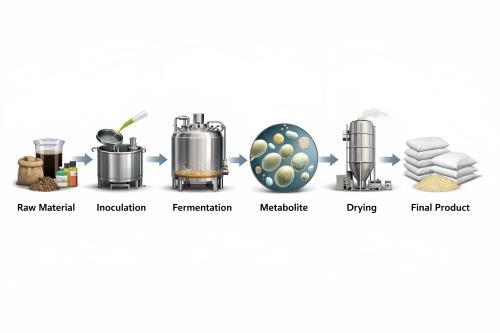
Step 1 – Raw Material Selection
The fermentation process begins with the selection of raw materials, which serve as the foundation for microbial growth and metabolite production.
Typical inputs include carbon sources such as molasses or glucose, nitrogen sources, and essential micronutrients. The consistency and purity of these raw materials directly affect microbial activity during fermentation.
Even small variations at this stage can lead to differences in fermentation efficiency and final product composition.
Step 2 – Strain Selection and Inoculation
The next step involves selecting and activating the microbial strain, most commonly Saccharomyces cerevisiae in yeast culture production.
The quality of the strain determines its metabolic capacity, stability, and adaptability to process conditions. During inoculation, strict control is required to ensure that the desired microorganism dominates the fermentation system.
In well-controlled production environments, this step ensures that yeast remains active and functional throughout the process, which is essential for producing high-quality yeast culture products used in feed applications.
Step 3 – Controlled Fermentation Process
Once inoculated, the system enters the core fermentation phase, where environmental conditions are carefully managed to guide microbial activity.
Key parameters include temperature, pH, oxygen supply, and fermentation time. These variables influence not only microbial growth but also the types and quantities of metabolites produced.
A stable and well-controlled fermentation process allows for predictable outcomes, while poor control can lead to incomplete fermentation, unwanted by-products, or inconsistent product quality.
Step 4 – Metabolite Formation and Functional Compounds
During fermentation, microorganisms produce a range of functional compounds, including organic acids, enzymes, peptides, and other metabolites.
These compounds play a critical role in improving nutrient digestibility, supporting gut health, and enhancing overall animal performance.
The effectiveness of a fermentation product is therefore closely linked to its metabolite composition. Understanding how fermentation conditions shape these compounds is essential when evaluating product performance. For a deeper explanation, see how fermentation metabolite profiles influence product quality.
Step 5 – Drying and Stabilization
After fermentation, the product must be stabilized to preserve its functional properties during storage and transportation.
Spray drying is commonly used to reduce moisture while maintaining the integrity of heat-sensitive compounds. This step requires careful balance—excessive heat can damage active components, while insufficient drying can reduce shelf life.
Stabilization is often where significant quality differences emerge between suppliers, even when upstream processes appear similar.
Step 6 – Quality Control and Batch Consistency
Consistent performance in the field depends on strict quality control throughout the production process.
Key aspects include microbial stability testing, contamination prevention, and batch-to-batch consistency verification. Without proper controls, variations in microbial activity or metabolite composition can lead to unpredictable results.
For buyers, one of the most important indicators of a reliable supplier is the ability to maintain stable production across batches. This is closely related to microbial stability in fermentation products, which directly impacts performance over time.

Common Problems in Low-Quality Fermentation Products
Products produced with insufficient process control often show several common issues:
- Inconsistent performance across batches
- Reduced microbial activity after storage
- Incomplete fermentation leading to lower metabolite levels
- Higher risk of contamination
These problems are not always visible in technical data sheets, but they can significantly affect real-world results.
How to Evaluate a Reliable Fermentation Product Supplier
When selecting a supplier, it is important to look beyond basic specifications and focus on production capability.
Key factors to consider include:
- Whether the supplier has a controlled and standardized fermentation process
- The ability to ensure batch consistency over time
- Transparency in quality control methods
- Technical support aligned with specific animal applications
Suppliers with strong process control are more likely to deliver stable, predictable performance in practical use.
Conclusion
Fermentation is not a simple or uniform process. The final product is shaped by multiple stages, each requiring precise control—from raw material selection to drying and stabilization.
For buyers, understanding these steps provides a clearer basis for evaluating product quality and selecting reliable partners. In fermentation-based feed additives, consistency is not achieved by chance, but by process control.
If you are evaluating fermentation-based feed additives and need consistent quality across batches, you can reach out to discuss your application and sourcing requirements.