
Once a yeast culture has been selected for a feed formulation, the next consideration is how to handle it during commercial feed production.
For a feed manufacturer, the practical questions are different from those involved in formulation. The focus shifts to product receiving, storage, premixing, mixing, processing, and post-processing handling.
A typical workflow is:
Receiving → Storage → Premixing → Mixing → Processing → Cooling → Packaging & Storage
The appropriate handling method depends on the specific yeast culture product, feed formulation, equipment, and processing conditions.
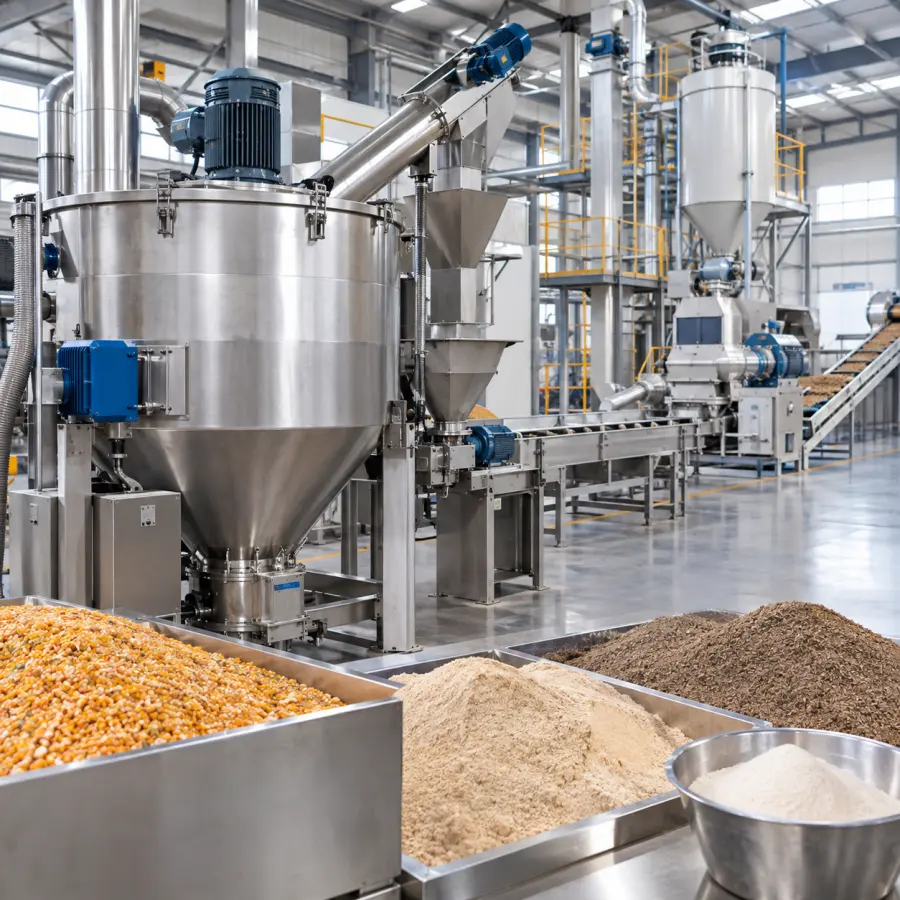
Where Yeast Culture Fits into Feed Manufacturing
Yeast culture can be introduced into a commercial feed production line as an individual dry ingredient or through an existing premix system.
The most appropriate addition method depends on factors such as:
- Inclusion rate
- Batch size
- Mixer configuration
- Product particle characteristics
- Existing premix procedures
- Downstream processing
The objective is straightforward: achieve consistent distribution of the product while fitting it into the feed mill’s established production process.
This is the manufacturing stage that follows formulation. For guidance on deciding how yeast culture fits into a feed formula, see How to Use Yeast Culture in Animal Feed Formulation.
Receiving and Storing Yeast Culture
Good handling starts before the product reaches the mixer.
When receiving a shipment, the production or warehouse team should check the product name, batch information, packaging condition, quantity, and relevant storage requirements.
Particular attention should be given to:
- Packaging integrity
- Batch or lot identification
- Shelf-life information
- Storage conditions
- Product documentation
Yeast culture should be stored according to the supplier’s specifications and protected from unnecessary exposure to moisture and unsuitable environmental conditions.
Keeping the original packaging properly closed until use can also help maintain product consistency and simplify batch traceability.
Premixing Yeast Culture Before Main Mixing
Because yeast culture may be included at a relatively low rate compared with major feed ingredients, premixing can be useful in some feed manufacturing systems.
A premix allows the product to be distributed through a larger quantity of compatible material before entering the main mixer.
When Is Premixing Useful?
Premixing may be considered when:
- The inclusion rate is relatively low
- The production batch is large
- Particle characteristics differ from major feed ingredients
- The existing feed mill uses a premix system
However, premixing is not automatically required for every yeast culture product.
The decision should be based on the product’s physical characteristics, inclusion rate, mixer configuration, and the feed mill’s validated production procedure.
Adding Yeast Culture During Feed Mixing
After any required premixing step, the yeast culture needs to be incorporated consistently into the main feed batch.
The addition point should fit the existing batching and mixing sequence rather than being treated as a separate process for every production line.
Important considerations include:
- Addition sequence
- Batch size
- Mixer capacity
- Mixing time
- Ingredient distribution
- Particle characteristics
Mixing Uniformity
For low-inclusion ingredients, distribution throughout the feed batch is particularly important.
Feed manufacturers should evaluate whether their existing mixing procedure provides adequate uniformity for the specific formulation and equipment.
Rather than applying a universal mixing time, the process should be validated according to the feed mill’s mixer, batch size, loading sequence, and operating conditions.
This is also why the physical characteristics of the yeast culture should be considered when establishing a commercial production procedure.
Yeast Culture During Feed Processing
After mixing, commercial feed may undergo conditioning, pelleting, cooling, or other processing steps.
These operations can introduce heat, moisture, pressure, and mechanical handling.
Conditioning and Pelleting
For pelleted feed, manufacturers should compare actual processing conditions with the specific product recommendations.
Relevant factors may include:
- Conditioning temperature
- Moisture addition
- Residence time
- Pelleting conditions
- Cooling after pelleting
The important point is that processing behavior should be evaluated product by product rather than assuming that all yeast culture products have identical processing characteristics.
For a deeper discussion of processing stability, see Heat Resistance and Processing Stability of Fermentation Products. That article covers the broader stability considerations, while this article focuses on how feed manufacturers should incorporate those considerations into production.
Post-Processing Handling
Handling continues after the feed leaves the pellet mill.
After processing, the feed normally passes through cooling, conveying, packaging, and storage. These steps should follow the feed mill’s established quality-control procedures while avoiding unnecessary exposure to unsuitable conditions.
Where a production system uses post-pellet application, this approach may also be considered for suitable products when supported by the product specification and manufacturing setup.
There is no universal requirement for post-pellet application. The appropriate method depends on the yeast culture product and the feed manufacturing process.
Packaging and Finished Feed Storage
Once the feed has been processed and cooled, packaging and storage become the final stages of the manufacturing workflow.
Finished feed should be protected from excessive moisture and unsuitable storage conditions. Packaging should remain intact, and batch identification should be maintained throughout storage and distribution.
For feed manufacturers, practical controls include:
- Packaging integrity
- Warehouse conditions
- Moisture exposure
- Stock rotation
- Shelf-life management
- Batch traceability
The storage requirements for the incoming yeast culture should not automatically be treated as the storage specification for finished feed. Each stage should follow its applicable product and feed requirements.
What Feed Manufacturers Should Confirm with a Yeast Culture Supplier
Before commercial production, several practical points should be confirmed with the supplier.
These may include:
- Recommended inclusion range
- Addition method
- Premixing recommendations
- Processing considerations
- Storage requirements
- Packaging and shelf life
- Batch documentation
- Product-specific technical specifications
This information allows the feed manufacturer to adapt the yeast culture to an existing production system rather than relying on generic handling assumptions.
For manufacturers comparing products, quality and consistency are also important considerations when assessing whether a yeast culture is suitable for commercial feed production. See Yeast Culture Quality for more information.
Conclusion
Using yeast culture successfully in commercial feed production involves more than adding the recommended amount to a formulation.
The product should be managed consistently from receiving and storage through premixing, mixing, processing, and finished-feed handling.
The exact procedure should be adapted to the yeast culture product, feed formulation, equipment, and processing conditions. Working from product-specific technical information helps feed manufacturers establish a practical and repeatable production process.