
Key Insights for Nutritionists & Procurement Teams
Choosing between yeast culture and live yeast is not simply a question of which product is better. These two yeast-based feed additives are developed with different functional mechanisms and are designed to address different nutritional objectives.
Live yeast works through the activity of viable yeast cells, while yeast culture delivers fermentation-derived functional compounds, including metabolites, peptides, and other nutritional factors produced during controlled fermentation.
For feed companies, the correct choice depends on:
- Animal species and production stage
- Feed processing conditions
- Nutritional objectives
- Storage requirements
- Target performance outcomes
Understanding the difference between these two technologies helps nutritionists and purchasing teams select the right animal feed yeast additive instead of relying on a one-size-fits-all approach.
What Is Live Yeast in Animal Feed?
Live yeast refers to yeast products containing viable yeast cells that remain metabolically active when included in animal diets.
The primary purpose of live yeast supplementation is to introduce active microorganisms into the digestive environment, where they interact with existing microbial populations.
In ruminants, especially dairy cattle, live yeast is widely studied because of its influence on rumen microbial balance.
The main mechanisms include:
| Function | Mechanism |
|---|---|
| Oxygen scavenging | Live yeast consumes residual oxygen in the rumen environment |
| Microbial support | Creates favorable conditions for beneficial rumen microorganisms |
| Fermentation modulation | Supports more stable rumen fermentation patterns |
Because live yeast depends on viable cell activity, product stability is strongly influenced by:
- Storage temperature
- Moisture exposure
- Feed processing conditions
- Product handling
What Is Yeast Culture in Animal Feed?
Yeast culture is a fermentation-derived feed ingredient produced through controlled yeast fermentation.
Unlike live yeast, the primary value of yeast culture does not depend on maintaining living cells.
Instead, yeast culture contains functional fermentation components, including:
- Fermentation metabolites
- Peptides
- Organic compounds
- Enzymatic substances
- Yeast-derived nutritional factors
The fermentation process creates a complex nutritional matrix that can support feed applications requiring consistency and functional performance.
For feed companies, yeast culture is often selected when the target is related to:
- Gut health management
- Feed efficiency optimization
- Stress-related nutritional challenges
- Antibiotic-free production strategies
- Stable performance under commercial feeding conditions
For more information about our yeast culture products, explore our fermentation-based feed solutions.
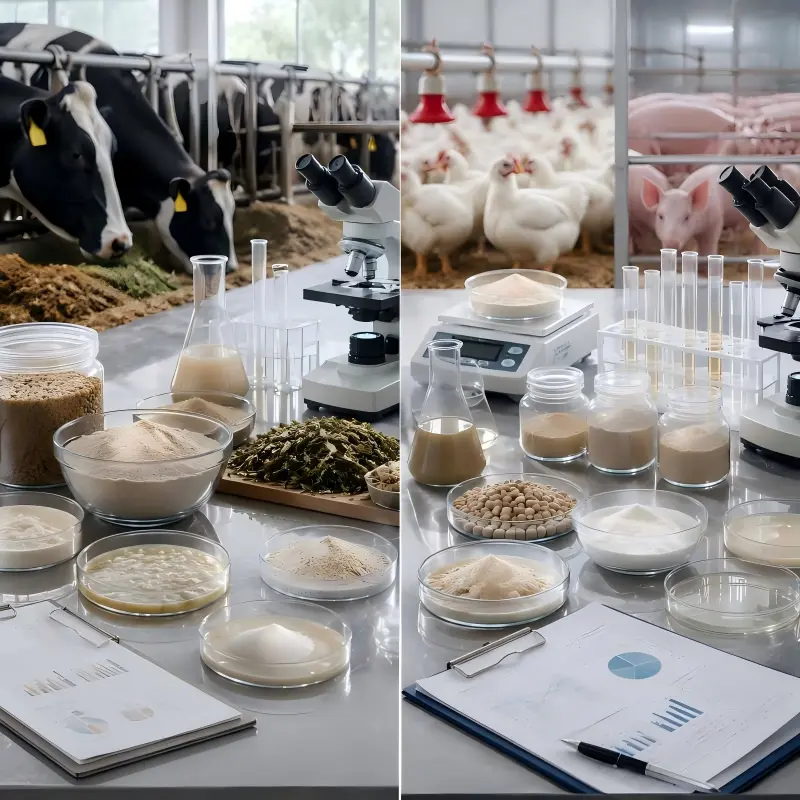
Yeast Culture vs Live Yeast: Key Differences
The two products are often grouped together as “feed yeast products”, but their functional characteristics are different.
| Comparison Factor | Live Yeast | Yeast Culture |
|---|---|---|
| Primary component | Viable yeast cells | Fermentation metabolites and nutritional compounds |
| Main mechanism | Microbial activity | Fermentation-derived functional effects |
| Dependence on cell survival | High | Low |
| Stability during processing | More sensitive | Generally more stable |
| Common application focus | Rumen microbial management | Gut health, feed efficiency, production stability |
| Typical target animals | Dairy cattle, ruminants | Poultry, swine, ruminants |
| Product consistency requirement | Cell viability control | Fermentation process control |
The key difference is:
Live yeast provides biological activity through living microorganisms, while yeast culture provides functional compounds generated during fermentation.
Which Feed Applications Prefer Live Yeast?
Dairy Cattle and Ruminant Production
Live yeast is commonly selected for ruminant applications where maintaining rumen microbial balance is a primary objective.
Typical applications include:
- High-producing dairy cattle
- High-forage diets
- Rumen fermentation management
- Transition period nutrition
In these situations, nutritionists often focus on:
- Stable rumen fermentation
- Fiber digestion efficiency
- Microbial population balance
Because the rumen is a complex microbial ecosystem, live yeast remains an important nutritional tool for specific ruminant applications.
For feed companies developing nutritional programs for dairy and beef production, understanding the relationship between yeast products and rumen function is essential. Our ruminant yeast culture solutions are designed for different cattle production stages, supporting nutrition strategies focused on digestive stability and production performance.
Which Feed Applications Prefer Yeast Culture?
Poultry Production
In poultry production, feed companies often prioritize:
- Intestinal health
- Feed conversion efficiency
- Stress resistance
- Production consistency
Because poultry diets frequently involve:
- High-density production systems
- Feed processing requirements
- Antibiotic-free production goals
Yeast culture is commonly selected as a fermentation-based nutritional solution.
Learn more about our poultry yeast culture solutions for commercial feed applications.
Swine Production
Young pigs and intensive swine production systems face challenges related to:
- Digestive development
- Feed intake stability
- Environmental stress
Yeast culture provides fermentation-derived compounds that support nutritional strategies focused on maintaining digestive stability.
For different production stages, product selection should consider:
- Piglet diets
- Grower-finisher programs
- Breeding animal nutrition
For swine producers and feed manufacturers evaluating yeast-based nutritional strategies, our swine yeast culture solutions provide application-focused options designed around different production requirements and feeding conditions.
Can Feed Companies Use Yeast Culture and Live Yeast Together?
Yes.
Yeast culture and live yeast are not necessarily competing products.
They work through different mechanisms:
- Live yeast focuses on viable microbial activity.
- Yeast culture provides fermentation-derived functional compounds.
Some nutritional programs combine both technologies when the production goal requires multiple functional approaches.
The decision depends on:
- Animal species
- Diet formulation
- Production objectives
- Cost-performance evaluation
How Should Feed Companies Choose Between Yeast Culture and Live Yeast?
Before selecting a yeast-based feed additive, purchasing teams should evaluate the following factors:
| Evaluation Question | Recommended Consideration |
|---|---|
| Is the target animal a ruminant? | Consider whether rumen microbial modulation is the main objective |
| Is the feed exposed to high processing temperatures? | Evaluate product stability requirements |
| Is the goal related to gut health and production consistency? | Consider fermentation-derived yeast culture products |
| Does the market require antibiotic-free production support? | Evaluate functional fermentation products |
| Is long-term batch consistency important? | Review manufacturer quality control systems |
A reliable selection process should consider both technical performance and supply reliability.
What Feed Companies Should Check Before Purchasing Yeast Products
Choosing a yeast product supplier requires more than comparing product names.
Procurement teams should evaluate:
1. Fermentation Technology
The production process directly affects:
- Metabolite profile
- Product consistency
- Functional performance
A professional yeast culture manufacturer should have controlled fermentation processes and quality verification procedures.
2. Product Specification and Quality Control
Important quality indicators include:
- Moisture content
- Microbial safety
- Nutritional consistency
- Batch-to-batch stability
- Traceability documentation
Consistency is especially important for feed companies that formulate products at commercial scale.
3. Application Support
A supplier should understand different animal production systems.
Technical support should include:
- Species-specific applications
- Feed formulation considerations
- Usage recommendations
Frequently Asked Questions About Yeast Culture and Live Yeast
Is yeast culture the same as inactive yeast?
No. Inactive yeast mainly refers to non-living yeast biomass or yeast-derived fractions, while yeast culture contains fermentation metabolites and functional compounds produced during controlled fermentation.
Which product survives feed processing better?
Yeast culture generally provides better processing stability because its primary functional components are fermentation-derived compounds rather than living cells.
However, actual stability depends on:
- Processing temperature
- Moisture conditions
- Formulation design
- Product specifications
Is live yeast always better than yeast culture?
No. The appropriate choice depends on the application.
Live yeast is valuable when viable microbial activity is the target, while yeast culture is often selected when fermentation-derived functional compounds are required.
Which product is more suitable for poultry feed?
Yeast culture is commonly selected for poultry applications because poultry production often focuses on gut health, feed efficiency, and production stability.
Can yeast culture replace all live yeast applications?
No. Yeast culture and live yeast serve different nutritional purposes.
Product selection should be based on:
- Animal species
- Production stage
- Feeding objectives
- Processing conditions
Conclusion: Selecting the Right Yeast Technology for Feed Applications
Yeast culture and live yeast are different nutritional technologies, not direct substitutes.
Live yeast provides value through viable microbial activity, while yeast culture delivers fermentation-derived functional compounds.
For feed companies, the best product choice depends on matching the yeast technology with the production challenge.
A professional supplier should provide not only products but also technical understanding, consistent quality, and application-based support.
Challenge Group develops fermentation-based yeast culture solutions for poultry, swine, and ruminant nutrition, supporting feed companies with reliable products and technical expertise.