
Key Insights
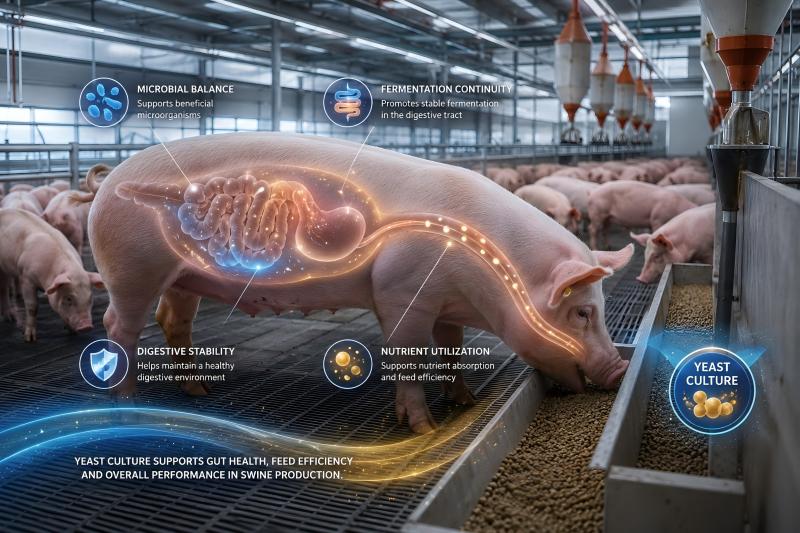
- Yeast culture supplementation supports digestive stability by helping maintain balanced intestinal microbiota and more consistent nutrient utilization in swine production systems.
- Fermentation continuity is increasingly important in modern commercial pig farming, where feed consistency and predictable performance directly affect operational efficiency.
- Field nutrition reports suggest yeast culture may improve feed conversion ratio (FCR) by approximately 2–5% under stress conditions such as heat stress or feed transitions.
- Industrial-grade yeast culture products designed for 85–90°C pelleting stability help maintain functionality during commercial feed manufacturing processes.
Introduction
Modern swine production systems are under constant pressure to improve feed efficiency, maintain animal health, and reduce production variability. In large-scale operations, even small fluctuations in digestive performance or feed conversion can significantly impact profitability.
As producers move toward more precision-focused nutrition programs, yeast culture for swine has become an increasingly important functional feed solution. Unlike basic nutritional ingredients, yeast culture products provide biologically active metabolites, peptides, enzymes, and fermentation compounds that support microbial balance and digestive stability.
In practical commercial environments, yeast culture supplementation is commonly associated with improved feed utilization, more stable intestinal fermentation patterns, and better resilience during stress periods such as weaning, heat stress, transportation, and dietary transitions.
For producers seeking more predictable feeding outcomes and reduced performance fluctuation, maintaining fermentation continuity has become a key nutritional objective in modern swine management.
What Is Yeast Culture for Swine?
Yeast culture is a fermented feed ingredient produced through controlled cultivation of beneficial yeast strains, most commonly Saccharomyces cerevisiae. Unlike live yeast products that primarily focus on delivering viable microorganisms, yeast culture contains a broader combination of fermentation metabolites and bioactive compounds generated during the fermentation process.
These compounds may include:
- Peptides and amino acid metabolites
- Organic acids
- Enzymes
- B vitamins
- Fermentation-derived growth factors
- Functional carbohydrate fractions
In swine nutrition, yeast culture is primarily used to support:
- Digestive stability
- Feed intake consistency
- Nutrient utilization
- Gut microbial balance
- Stress resilience
- Feed conversion efficiency
Because modern pig production systems often involve high stocking density, rapid growth targets, and environmental stressors, maintaining microbial balance inside the digestive tract is increasingly viewed as a critical production factor.
Why Digestive Stability Matters in Modern Swine Production
Digestive instability creates both biological and economic risks in commercial swine systems. Even moderate disruptions in gut health may lead to:
- Reduced feed intake
- Lower nutrient absorption
- Inconsistent growth rates
- Increased feed waste
- Greater sensitivity to environmental stress
- Higher management costs
Starter pigs are particularly vulnerable because their digestive and immune systems are still developing. During weaning transitions, sudden dietary changes and environmental stress can disrupt intestinal microbial balance.
In grower and finisher operations, inconsistent fermentation patterns may reduce feed efficiency and create performance variation across production groups.
This is why many commercial nutrition programs increasingly focus on maintaining stable fermentation conditions and predictable microbial activity rather than only maximizing short-term growth performance.
How Yeast Culture Works in Swine Nutrition
Support for Beneficial Microbial Activity
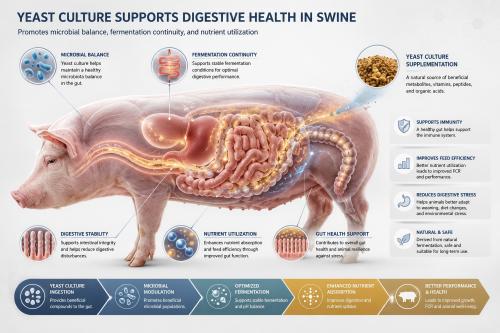
Yeast culture provides metabolites and fermentation compounds that help create a more favorable intestinal environment for beneficial microorganisms.
Field nutrition observations suggest this may contribute to:
- More stable microbial populations
- Improved digestive consistency
- Reduced intestinal stress during feed transitions
Rather than acting as a direct pharmaceutical solution, yeast culture works through nutritional and microbial support mechanisms that help stabilize the digestive ecosystem.
Improved Nutrient Utilization
Certain fermentation metabolites and enzyme activities associated with yeast culture may help improve nutrient availability inside the digestive tract.
Research and commercial feeding reports indicate that supplementation may contribute to:
- Better fiber utilization
- More consistent digestion
- Improved energy extraction from feed ingredients
Under practical commercial conditions, this may help improve feed conversion efficiency and reduce unnecessary feed loss.
Field reports suggest FCR improvements of approximately 2–5% may be achievable under heat stress or high-performance production environments when yeast culture is integrated into balanced nutritional programs.
Fermentation Continuity in Large-Scale Operations
One of the most important concepts in modern commercial feeding systems is fermentation continuity — the ability to maintain stable and predictable digestive fermentation patterns over time.
Large-scale swine operations often face challenges such as:
- Feed ingredient variability
- Heat stress
- Group density pressure
- Transportation stress
- Feed processing fluctuations
Yeast culture supplementation is increasingly used as part of broader strategies designed to support more continuous and predictable fermentation performance.
For integrated commercial systems, reducing performance fluctuation is often just as important as maximizing peak performance.
Problem → Mechanism → Outcome
| Problem | Mechanism | Outcome |
|---|---|---|
| Digestive instability during weaning | Yeast metabolites support microbial balance and digestive consistency | Improved gut stability and reduced performance fluctuation |
| Poor feed conversion efficiency | Fermentation compounds may enhance nutrient utilization | Better FCR and improved feed efficiency |
| Heat stress and reduced feed intake | Functional metabolites help support fermentation continuity | More stable intake patterns under stress conditions |
| Variability in large-scale production | Supports predictable digestive activity across feeding cycles | Improved operational consistency |
| High-temperature feed processing | Industrial-grade formulations support pelleting stability at 85–90°C | Reliable functionality after feed manufacturing |
Applications of Yeast Culture in Swine Diets
Starter Pig Programs
Starter pigs experience major digestive and environmental stress during weaning transitions. Yeast culture is commonly included in starter diets to support intestinal stability during this sensitive period.
Commercial nutrition programs may use yeast culture to help support:
- Early feed intake
- Digestive adaptation
- Microbial balance
- Reduced post-weaning performance disruption
Some field observations suggest starter pig programs using yeast culture may achieve more consistent early growth performance compared with unstable feeding environments.
Grower and Finisher Diets
In grower and finisher operations, feed efficiency becomes one of the primary economic performance indicators.
Yeast culture supplementation in these phases is commonly associated with:
- Improved nutrient utilization
- More consistent weight gain
- Better feeding stability
- Reduced performance variation across groups
Research and field feeding programs indicate average daily gain (ADG) improvements of approximately 3–4% may occur when fermentation stability is maintained under optimized nutritional conditions.
Heat Stress and Environmental Challenges
Heat stress remains a major challenge in commercial pig production, particularly in regions with high summer temperatures or limited ventilation efficiency.
Under heat stress conditions, pigs often experience:
- Lower feed intake
- Digestive disruption
- Reduced growth efficiency
- Greater oxidative stress
Yeast culture is increasingly integrated into heat stress nutritional programs because fermentation stability and digestive consistency become especially important during environmental pressure periods.
Industrial Feed Processing Considerations
Not all yeast culture products perform equally under commercial manufacturing conditions.
In modern feed mills, pelleting temperatures commonly reach 85–90°C, which can negatively affect sensitive biological ingredients.
For export-oriented and industrial-scale feed manufacturers, selecting yeast culture products with strong thermal stability is important for maintaining product consistency after processing.
Industrial buyers often prioritize:
- Stable fermentation performance
- Consistent batch quality
- Reliable pelleting stability
- Uniform mixing characteristics
- Scalable manufacturing compatibility
These operational considerations are especially important in integrated commercial feed systems where production consistency directly affects economic outcomes.
Certifications & Compliance
For international feed manufacturers and distributors, product safety and manufacturing compliance are essential purchasing considerations.
High-quality yeast culture suppliers commonly operate under internationally recognized production and quality systems such as:
- FAMI-QS
- ISO 22000
- HACCP
- GMP-compliant manufacturing systems
- Non-GMO production standards
These certifications help support:
- Feed safety traceability
- Export compliance
- Batch consistency
- International trade reliability
- Quality assurance for commercial feed production
For global buyers, manufacturing transparency and documented quality systems are increasingly viewed as critical supplier selection criteria.
How to Select the Right Yeast Culture Supplier
Choosing the right yeast culture supplier involves more than comparing price alone.
Commercial feed manufacturers and distributors often evaluate suppliers based on:
- Production consistency
- Technical support capabilities
- Thermal stability performance
- Fermentation technology experience
- Export logistics reliability
- Custom formulation support
- Application-specific solutions
For swine operations, selecting a supplier with experience in large-scale commercial feeding systems is particularly important because practical field performance may vary depending on feed formulation, management conditions, and production objectives.
For companies seeking customized feeding strategies for commercial pig operations, our Swine Solutions page explores how fermentation-focused nutritional programs can support more stable production performance.
Our Enzyme PLUS – Swine Use solutions are specifically developed for modern commercial swine systems where digestive consistency and feed efficiency are operational priorities.
You can also explore practical feeding applications through our Application Areas resources covering commercial livestock production environments.
Common Misconceptions About Yeast Culture for Swine
Can yeast culture completely replace antibiotics in starter pigs?
Yeast culture may contribute to digestive stability and support gut health management strategies, but it is not considered a direct pharmaceutical replacement for antibiotics.
Most commercial programs use yeast culture as part of a broader integrated nutritional and management approach.
Is yeast culture the same as yeast cell wall?
No. Yeast culture and yeast cell wall products are different categories of feed ingredients.
Yeast culture primarily contains fermentation metabolites and biologically active compounds generated during fermentation, while yeast cell wall products mainly focus on structural carbohydrate fractions such as beta-glucans and mannan oligosaccharides.
Does yeast culture only benefit young pigs?
No. While starter pigs often receive significant benefits from digestive support, yeast culture is also widely used in grower and finisher programs where feed efficiency and fermentation continuity are important economic factors.
Can yeast culture survive pelleting?
Product performance depends on formulation quality and manufacturing technology.
Industrial-grade yeast culture products designed for commercial feed systems may maintain functionality under pelleting temperatures of approximately 85–90°C.
Conclusion
As modern swine production systems continue evolving toward higher efficiency and greater operational precision, maintaining digestive stability and fermentation continuity has become increasingly important.
Yeast culture supplementation offers a practical nutritional strategy for supporting:
- Feed efficiency
- Microbial balance
- Digestive consistency
- Stress resilience
- Production predictability
For commercial swine operations, the goal is no longer simply maximizing short-term growth performance. Increasingly, producers are prioritizing stable, repeatable, and economically sustainable feeding outcomes across large-scale production systems.
Companies seeking long-term improvements in feed utilization and operational consistency are increasingly integrating yeast culture into comprehensive swine nutrition strategies designed for modern commercial production environments.