
Key Insights
- Primary Function: Supporting rumen fermentation continuity in high-producing dairy cattle under high-concentrate TMR feeding systems.
- Operational Value: Helping maintain feed intake consistency during heat stress and transition periods.
- Production Focus: Supporting stable milk production through improved microbial efficiency and fiber utilization.
- Commercial Relevance: Widely used in large-scale dairy operations where fermentation stability directly affects herd performance consistency.
Introduction
Modern dairy production systems place increasing pressure on rumen function due to higher milk production demand, intensive feeding programs, and environmental stress conditions.
High-producing dairy cows commonly rely on high-concentrate TMR diets to sustain energy supply during lactation. However, these feeding systems can also increase the risk of fermentation fluctuation, inconsistent feed intake, and reduced rumen stability.
Under these conditions, maintaining stable rumen fermentation becomes one of the most important factors influencing nutrient utilization and lactation consistency.
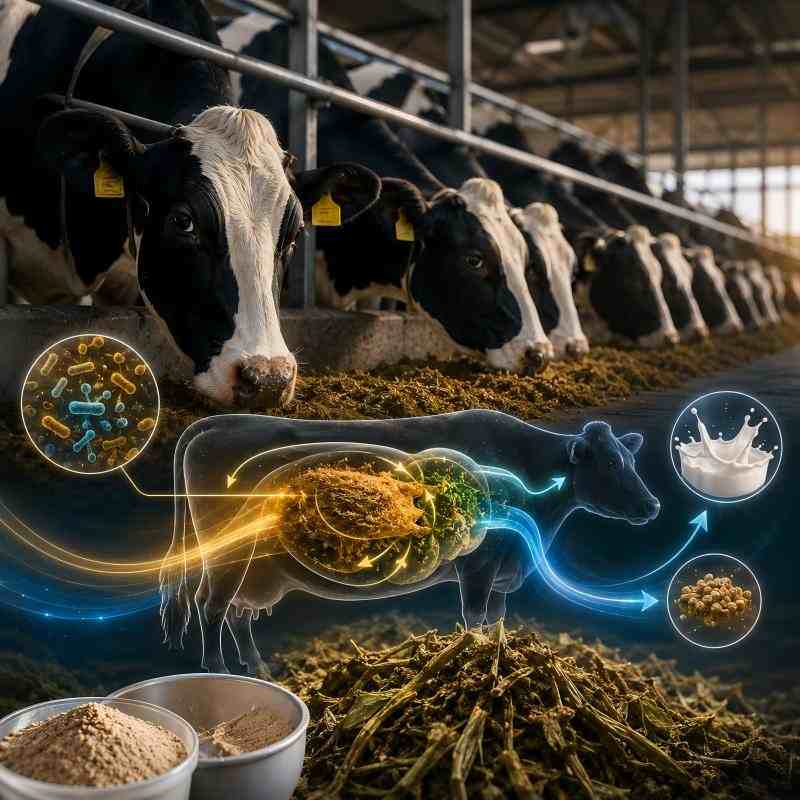
Yeast culture for dairy cattle is widely used as a fermentation-derived feed additive designed to support rumen microbial balance, improve fiber utilization, and maintain more consistent digestive performance in modern dairy systems.
Rather than functioning as a direct nutrient source, yeast culture acts primarily as a rumen stability support tool, helping dairy cows maintain more predictable fermentation performance under production stress conditions.
For a broader overview of how fermentation-derived additives support dairy and beef production systems, see our analysis of how yeast culture supports rumen function and feeding applications in ruminants.
Why Rumen Stability Matters in Dairy Cattle
High-Producing Dairy Cows and Fermentation Stress
Modern dairy cows require large amounts of rapidly available energy to sustain milk production.
To meet this demand, dairy diets often contain high levels of fermentable carbohydrates. While effective for supporting energy intake, these diets can also create unstable rumen conditions characterized by rapid fermentation shifts and microbial imbalance.
In commercial dairy operations, the objective is not simply increasing fermentation intensity, but maintaining fermentation continuity across changing feeding and environmental conditions.
This consistency is important for:
- maintaining stable feed intake
- supporting lactation persistence
- reducing digestive fluctuation
- improving production predictability
Fiber Digestion and Nutrient Utilization
Efficient forage utilization remains one of the most important factors influencing dairy cow performance.
Yeast culture supports cellulolytic microbial activity involved in structural carbohydrate breakdown, improving forage digestion efficiency and nutrient extraction from roughage ingredients.
📊 Field nutrition observations suggest improvements in NDF digestibility of approximately 5–10%, depending on forage quality and ration structure.
For dairy systems heavily dependent on silage and forage-based TMR programs, this improvement may contribute to more stable energy utilization throughout lactation.
The relationship between microbial activity and forage utilization is explored further in our detailed analysis of how yeast culture improves fiber digestibility and forage utilization in ruminant feeding systems.
How Yeast Culture Supports Dairy Cow Performance
Supporting Rumen Fermentation Stability
The rumen operates as a highly dynamic microbial ecosystem that requires environmental stability for efficient fermentation.
Yeast culture supports this stability by helping maintain microbial balance and promoting more consistent fermentation patterns under high-energy feeding conditions.
📊 Commercial dairy feeding observations suggest that yeast culture supplementation may contribute to improved rumen pH stability under intensive TMR feeding systems.
This stabilization becomes particularly important in high-producing herds where fermentation inconsistency can rapidly affect intake behavior and lactation performance.
Supporting Milk Production Efficiency
Stable rumen fermentation directly affects the availability of volatile fatty acids (VFAs), which are important energy sources for milk synthesis.
By supporting microbial efficiency and nutrient utilization consistency, yeast culture helps maintain more stable lactation performance under demanding production conditions.
📊 Commercial dairy nutrition reports suggest that yeast culture supplementation may contribute to improvements in milk production consistency of approximately 1–2.5% under stress-sensitive feeding conditions.
Supporting Dairy Cows During Heat Stress
Heat stress remains one of the most significant environmental challenges in dairy production systems.
Elevated temperatures commonly reduce feed intake and disrupt microbial balance, negatively affecting production efficiency.
Yeast culture is frequently included in summer dairy feeding programs to support:
- feed intake consistency
- microbial stability
- nutrient utilization efficiency
This role becomes especially important in large commercial dairy herds where intake fluctuation can significantly affect overall production performance.
Common Applications in Modern Dairy Systems
| Dairy Production Challenge | Yeast Culture Functional Role | Operational Outcome |
|---|---|---|
| High-Concentrate TMR Feeding | Supports rumen fermentation continuity | More stable rumen pH and digestion consistency |
| Transition Period Stress | Supports cellulolytic microbial activity | Improved dry matter intake adaptation |
| Heat Stress Conditions | Helps maintain microbial balance | Reduced feed intake fluctuation |
| High Milk Production Demand | Supports VFA production efficiency | Improved nutrient utilization stability |
| Large-Scale Dairy Operations | Supports fermentation consistency across variable feeding conditions | Improved herd-level production predictability |
Feeding Scenarios Where Yeast Culture Delivers the Highest Value
Early Lactation Feeding Programs
Fresh cows experience high metabolic pressure combined with rapidly increasing nutrient demand.
Yeast culture is commonly used to support fermentation continuity and maintain more stable intake patterns during this period.
High-Concentrate TMR Systems
Modern dairy diets commonly rely on high levels of fermentable carbohydrates to sustain milk production.
Under these feeding conditions, yeast culture helps support microbial adaptation and more consistent fermentation activity.
Large-Scale Commercial Dairy Farms
In large dairy operations, consistency is often more important than short-term production spikes.
Yeast culture supports more predictable fermentation behavior across varying feeding and management conditions.
Key Factors in Selecting a Yeast Culture Feed Additive
Pelleting Stability and Industrial Processing Resistance
For commercial feed manufacturers and large-scale dairy operations, processing stability is an important procurement consideration.
If a yeast culture product loses functional metabolite activity during pelleting at 85–90°C, the expected rumen stabilization effect may be significantly reduced before the feed reaches the animal.
High-quality yeast culture products are designed to maintain functional integrity during:
- pelleting
- TMR mixing
- feed storage
- commercial feed mill processing
This type of processing stability is particularly important in industrial dairy nutrition programs.
Functional Metabolite Consistency
In dairy cattle applications, evaluating a yeast culture product based solely on live cell count may not fully reflect its functional performance.
For fermentation-derived yeast culture products, consistency of metabolite composition and processing stability are often more relevant indicators in large-scale feeding systems.
The effectiveness of yeast culture depends heavily on the consistency of fermentation-derived compounds such as peptides, organic acids, and micronutrient metabolites.
Variability in fermentation processes can significantly influence product performance under commercial dairy conditions.
Compatibility With TMR Feeding Systems
Modern dairy operations require feed additives that integrate smoothly into TMR systems without negatively affecting ration consistency or processing efficiency.
This is especially important in large commercial farms where ration uniformity directly affects herd-level production consistency.
Advanced Mechanism Summary
Yeast culture supports dairy cow performance through three primary functional pathways:
| Functional Pathway | Biological Target | Production Relevance |
|---|---|---|
| Microbial Activation | Cellulolytic bacteria activity | Improved fiber digestion efficiency |
| Fermentation Continuity | Rumen microbial stability | More consistent feed intake and digestion |
| Nutrient Utilization Support | VFA production efficiency | Improved lactation energy availability |
For commercial operations seeking broader feeding strategies for dairy and beef production systems, explore our ruminant dairy and beef nutrition solutions designed for modern high-performance feeding programs.
Conclusion: Yeast Culture as a Dairy Fermentation Stability Tool
Yeast culture for dairy cattle is widely used in modern dairy nutrition programs to support rumen stability, fermentation continuity, and feed intake consistency under high-production conditions.
Its value is particularly important in:
- high-concentrate TMR systems
- heat stress conditions
- transition feeding programs
- large-scale commercial dairy operations
Rather than functioning as a direct production stimulant, yeast culture acts primarily as a rumen ecosystem stabilizer, helping dairy cows maintain more consistent digestion and nutrient utilization across variable feeding conditions.
As dairy systems continue moving toward higher production intensity and tighter operational efficiency, maintaining stable rumen fermentation becomes increasingly important for long-term herd performance consistency.