
Introduction
Why do some yeast-based feed additives deliver consistent performance in livestock, while others show little to no effect?
The difference often lies not in the microbial species itself, but in fermentation quality and the resulting metabolite profile. Two products labeled as Saccharomyces cerevisiae culture can behave very differently depending on how they are produced.
Understanding this difference is essential for selecting reliable, high-performance fermentation products.
What Is Fermentation Quality?
Fermentation quality is not simply about whether microbial growth has occurred. It reflects the overall effectiveness and stability of the fermentation process, including:
-
Microbial activity and viability
-
Process control and consistency
-
Diversity and concentration of beneficial compounds
More importantly, fermentation quality determines not just what is produced, but how consistently it performs in animal systems.
What Are Metabolite Profiles in Fermentation?
A metabolite profile refers to the composition and distribution of functional compounds generated during fermentation.
These compounds are the real drivers behind performance in feed applications.
Major Metabolites Produced During Yeast Fermentation
-
Organic acids (support gut pH balance)
-
Peptides and amino acids (enhance nutrient utilization)
-
Vitamins, especially B-complex (support metabolism)
-
Enzymes (assist digestion and feed breakdown)
Structural Components vs. Fermentation Metabolites (Key Distinction)
It is important to distinguish between:
-
Fermentation metabolites → produced during the fermentation process
-
Cell structural components → inherent parts of the yeast cell
For example:
-
β-glucans and mannan oligosaccharides (MOS) are cell wall components, not metabolites
-
They become functionally available after cell processing or digestion, but are not direct outputs of fermentation metabolism
This distinction is critical when evaluating product claims and understanding functional mechanisms.
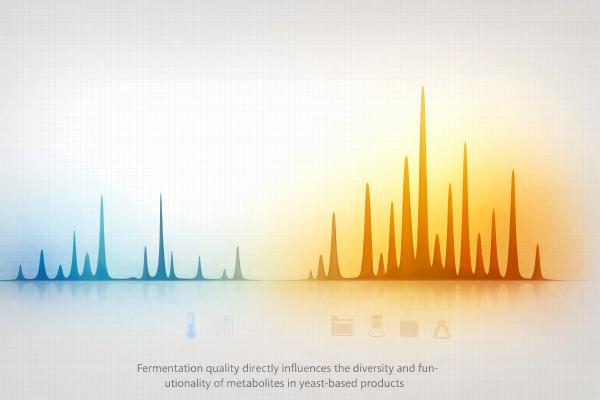
How Fermentation Quality Affects Metabolite Profiles
Different fermentation conditions directly shape the metabolite profile.
Strain Selection
Different yeast strains produce different metabolic outputs.
Fermentation Conditions
-
Temperature
-
Oxygen availability
-
pH control
Even small variations can significantly alter metabolite composition.
Substrate Composition
The nutrients used in fermentation influence what metabolites are generated and in what proportions.
As a result:
Different processes → Different metabolite profiles → Different performance outcomes
Why Metabolite Profiles Matter in Animal Nutrition
The effectiveness of fermentation products comes from these metabolites, not just microbial presence.
Gut Microbiota Modulation
Supports beneficial microbial balance
Enzyme Activity Enhancement
Improves feed digestibility and nutrient release
Immune Support
Certain compounds help regulate immune responses
Feed Efficiency Improvement
Better nutrient utilization leads to improved performance
These functional benefits are closely linked to the quality and diversity of the metabolite profile.
To better understand how these metabolites translate into improved feed utilization, see our detailed explanation in how yeast culture improves nutrient digestibility: mechanisms explained.
How to Evaluate Fermentation Product Quality (Practical Guide)
When selecting a fermentation-based feed additive, consider the following:
Consistency Between Batches
Reliable products show minimal variation in performance.
Transparency of Fermentation Process
Suppliers should provide insight into production methods and quality control.
Metabolite Richness (Not Just Cell Count)
A common misconception is that higher microbial counts (CFU) automatically mean better quality.
In reality:
-
High cell count only indicates microbial quantity
-
It does not guarantee the presence of functional metabolites
-
Poorly controlled fermentation can produce high biomass but low-value outputs
What truly matters is whether the product contains a rich and functional metabolite profile, not just live cells.
Stability in Storage and Use
Metabolites should remain stable during storage, transport, and feed processing.
Common Misconceptions About Fermentation Quality
“Higher CFU Means Better Quality”
Not necessarily—function depends on metabolites, not just cell numbers.
“Single Strain Is Always Better”
Performance depends on fermentation output, not just strain purity.
“Faster Fermentation Means Higher Efficiency”
Rapid processes may compromise metabolite development and stability.
Conclusion
Fermentation quality is the foundation that determines the structure and effectiveness of metabolite profiles.
In turn, metabolite profiles are what ultimately drive animal performance—from gut health to feed efficiency.
Choosing the right fermentation product is not about selecting a species name, but about selecting a well-controlled process that consistently delivers functional metabolites.