
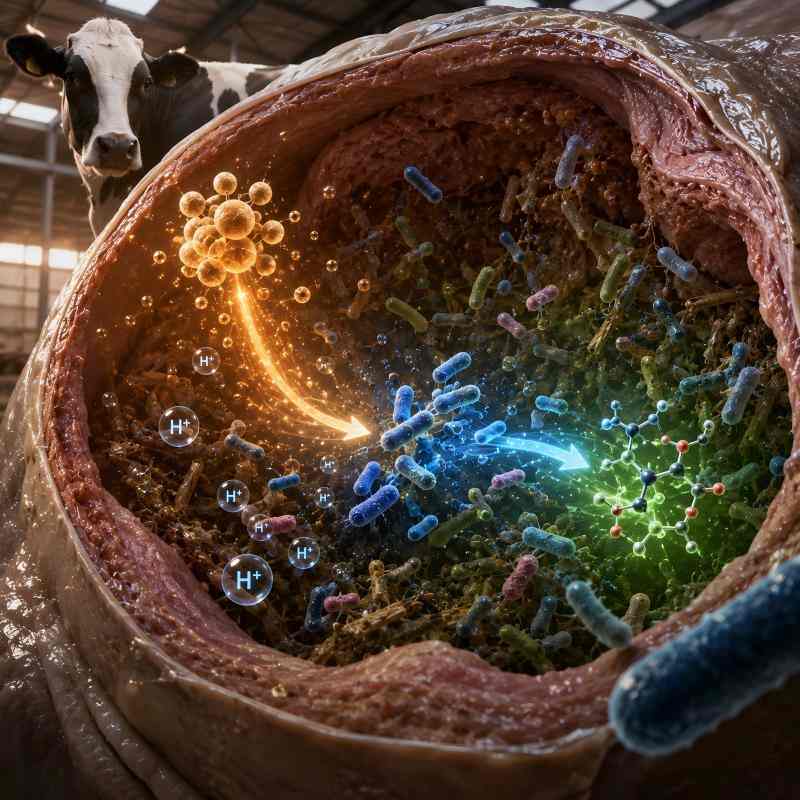
Key Insights
- Rumen pH stability is closely linked to the efficiency of lactate utilization inside the rumen ecosystem.
- Yeast culture does not function as a direct chemical buffer. Its primary role is supporting microbial pathways involved in lactate turnover.
- Yeast-derived metabolites such as B vitamins, peptides, and free amino acids may help support lactate-utilizing bacteria including Megasphaera elsdenii and Selenomonas ruminantium.
- Faster lactate-to-propionate conversion helps reduce hydrogen ion ($H^+$) accumulation and contributes to microbial equilibrium.
Introduction
Rumen pH instability does not begin with low pH values. It begins with the loss of microbial control over lactate turnover.
Inside the rumen, acids are continuously produced, metabolized, recycled, and absorbed. This makes the rumen a highly dynamic biochemical ecosystem rather than a static fermentation chamber.
Among all fermentation intermediates, lactate plays a particularly important role because it is closely linked to hydrogen ion accumulation, microbial stress, and acid persistence. When lactate production exceeds lactate utilization capacity, the rumen environment can shift from microbial equilibrium toward biochemical instability.
This is why modern rumen microbiology increasingly focuses on lactate turnover efficiency rather than pH measurements alone. Within this metabolic network, yeast culture is gaining attention not because it directly neutralizes acid, but because it may support the microbial populations responsible for lactate clearance.
Many modern nutrition programs are increasingly evaluating how rumen-focused yeast culture solutions support microbial continuity during unstable fermentation conditions.
Why Rumen pH Stability Depends on Lactate Turnover
Rumen pH is not simply a number. It is the result of microbial acid turnover efficiency.
During rapid fermentation, microbial populations produce large amounts of fermentation intermediates. One of the most important is lactate.
When lactate begins accumulating faster than it can be metabolized, hydrogen ion concentration also rises.
Microbial Instability Sequence
Lactate Accumulation
→ Hydrogen Ion (H+) Accumulation
→ Microbial Stress
→ Reduced Lactate Clearance
→ Biochemical Instability
Unlike some volatile fatty acids that are rapidly absorbed, lactate can persist longer inside the rumen when microbial utilization pathways become overloaded.
This persistence creates biochemical pressure throughout the microbial ecosystem. The key issue is not simply acid production. The real issue is whether the rumen microbial community can continuously recycle and metabolize those acids efficiently.
The Biochemical Link Between Lactate and Hydrogen Ion Stress
Lactate metabolism is directly connected to hydrogen ion regulation inside the rumen.
During carbohydrate fermentation, pyruvate can be converted into lactate through microbial metabolic pathways.
Basic Metabolic Pathway
Pyruvate
→ Lactate
→ Hydrogen Ion (H+) Stress
As lactate persistence increases, free hydrogen ions also accumulate. This biochemical stress affects microbial populations long before visible fermentation disorders appear. Excessive $H^+$ accumulation may interfere with the proton motive force across microbial cell membranes, reducing microbial energy transport efficiency and weakening metabolic activity.
This means acid stress is not merely a chemical issue. It is also a microbial energy regulation problem.
What Happens During Hydrogen Ion Stress?
| Biological Effect | Microbial Consequence |
|---|---|
| Excessive $H^+$ accumulation | Increased cellular stress |
| Proton motive force disruption | Reduced microbial energy efficiency |
| Lower metabolic activity | Slower lactate utilization |
| Reduced microbial balance | Greater acid persistence |
As microbial efficiency declines, lactate clearance slows even further.
This creates a self-reinforcing instability cycle inside the rumen environment.
How Lactate-Utilizing Bacteria Help Stabilize the Rumen Environment
Several microbial populations help prevent lactate accumulation by metabolizing lactate into downstream fermentation products.
Among the most important are:
- Megasphaera elsdenii
- Selenomonas ruminantium
These organisms are commonly described as lactate-utilizing bacteria because they actively consume lactate inside the rumen ecosystem. Their role is critically important for maintaining rumen microbial stability.
Rather than allowing lactate to persist, these bacteria convert lactate into propionate and related metabolites.
Lactate Conversion Pathway
Lactate
→ Propionate Conversion
→ Reduced Acid Persistence
→ Improved Microbial Stability
This conversion pathway helps reduce prolonged acid exposure and limits excessive hydrogen ion accumulation.
Key Lactate Utilizers in the Rumen
| Microbial Population | Biological Role |
|---|---|
| Megasphaera elsdenii | Converts lactate into propionate |
| Selenomonas ruminantium | Helps reduce lactate persistence |
| Lactate-utilizing bacteria | Support acid turnover efficiency |
| Propionate-producing microbes | Contribute to biochemical equilibrium |
The efficiency of these microbial pathways often determines whether rumen fermentation remains biologically stable.
Importantly, these bacteria depend heavily on surrounding microbial ecology and nutrient availability.
This is where yeast culture metabolites become biologically relevant.
Why Yeast Metabolites Matter in Lactate Utilization Pathways
The role of yeast culture is closely connected to the metabolites released during yeast fermentation and cellular activity.
These metabolites include:
- Free amino acids
- Peptides
- B vitamins
- Organic growth factors
- Fermentation cofactors
Rather than functioning as direct acid neutralizers, these compounds may act as microbial support nutrients inside the rumen ecosystem.
This distinction is extremely important.
The biological value of yeast culture is not simply “stimulating fermentation.”
Its deeper role may involve supporting microbial populations responsible for lactate turnover and biochemical equilibrium.
How Yeast Metabolites Support Microbial Stability
| Yeast-Derived Component | Potential Function |
|---|---|
| B vitamins | Support microbial enzymatic pathways |
| Free amino acids | Support microbial replication |
| Peptides | Provide accessible nitrogen sources |
| Fermentation cofactors | Support metabolic activity |
Research and field observations increasingly suggest that these metabolites may help create more favorable conditions for lactate-utilizing bacteria.
Yeast-Supported Microbial Pathway
Yeast Metabolites
→ Microbial Nutrient Support
→ Lactate-Utilizing Bacteria Activation
→ Propionate Formation
→ Reduced Acid Persistence
→ Biochemical pH Stability
This microbial support mechanism is becoming increasingly important in intensive production environments.
Different feeding systems may place very different levels of metabolic pressure on the rumen ecosystem, particularly across intensive ruminant production applications.
Lactate-to-Propionate Conversion as a Biological Stabilization Mechanism
One of the most important biological control systems inside the rumen is the conversion of lactate into propionate.
When this pathway functions efficiently, acid persistence decreases significantly.
Unlike chemical buffering systems, microbial lactate conversion actively removes unstable metabolic intermediates before acid pressure becomes excessive.
This is a biological stabilization mechanism rather than a simple acid-neutralization process.
Problem → Mechanism → Outcome
| Problem | Mechanism | Outcome |
|---|---|---|
| Lactate accumulation | Activation of lactate-utilizing bacteria | Faster lactate clearance |
| Hydrogen ion persistence | Lactate-to-propionate conversion | Reduced acid pressure |
| Microbial stress | Yeast metabolite support | Improved microbial resilience |
| Fermentation instability | Continuous acid turnover | Better rumen equilibrium |
The result is not simply a higher pH value.
The result is a more stable microbial ecosystem capable of maintaining fermentation continuity under changing rumen conditions.
Why pH Stability Is Better Viewed as Microbial Equilibrium
Modern rumen microbiology increasingly recognizes that rumen pH stability is fundamentally an ecological phenomenon.
Fermentation naturally generates acids continuously.
A biologically stable rumen is therefore not defined by the absence of acid production.
Instead, stability depends on whether microbial populations can efficiently recycle fermentation intermediates and maintain balanced metabolic turnover pathways.
Biological Stability Depends On:
- Continuous lactate utilization
- Efficient propionate formation
- Controlled hydrogen ion persistence
- Stable microbial cross-feeding
- Long-term fermentation continuity
From this perspective, yeast culture functions less like a direct feed additive and more like a microbial metabolic support system.
As microbial stability becomes increasingly important in modern dairy and beef systems, many producers are adopting broader ruminant fermentation continuity programs focused on long-term rumen ecosystem resilience.
Conclusion
Rumen pH stability is ultimately a microbial metabolic outcome.
The accumulation of lactate and hydrogen ions creates biochemical pressure capable of disrupting microbial equilibrium inside the rumen ecosystem.
Microbial populations such as Megasphaera elsdenii and Selenomonas ruminantium help reduce this pressure by converting lactate into propionate and limiting acid persistence. Within this biological framework, yeast culture may support lactate turnover indirectly through metabolites such as B vitamins, peptides, amino acids, and microbial cofactors.
Rather than functioning as a direct chemical buffer, yeast culture may help sustain the microbial pathways responsible for continuous acid recycling and fermentation stability.
Ultimately, stable rumen pH should be viewed not as a static measurement, but as the result of efficient microbial coordination, biochemical balance, and continuous lactate turnover inside the rumen environment.