
Key Insights
- Oxidative stress is becoming increasingly common in modern livestock systems due to higher metabolic intensity, stocking density, and environmental fluctuations.
- Excess reactive oxygen species (ROS) may disrupt mitochondrial efficiency, membrane integrity, and cellular energy allocation before visible production decline occurs.
- Endogenous antioxidant enzymes such as SOD, GSH-Px, and CAT are central to maintaining long-term oxidative balance inside animal cells.
- Yeast culture metabolites are increasingly studied for their potential role in supporting oxidative resilience through multi-pathway metabolic regulation.
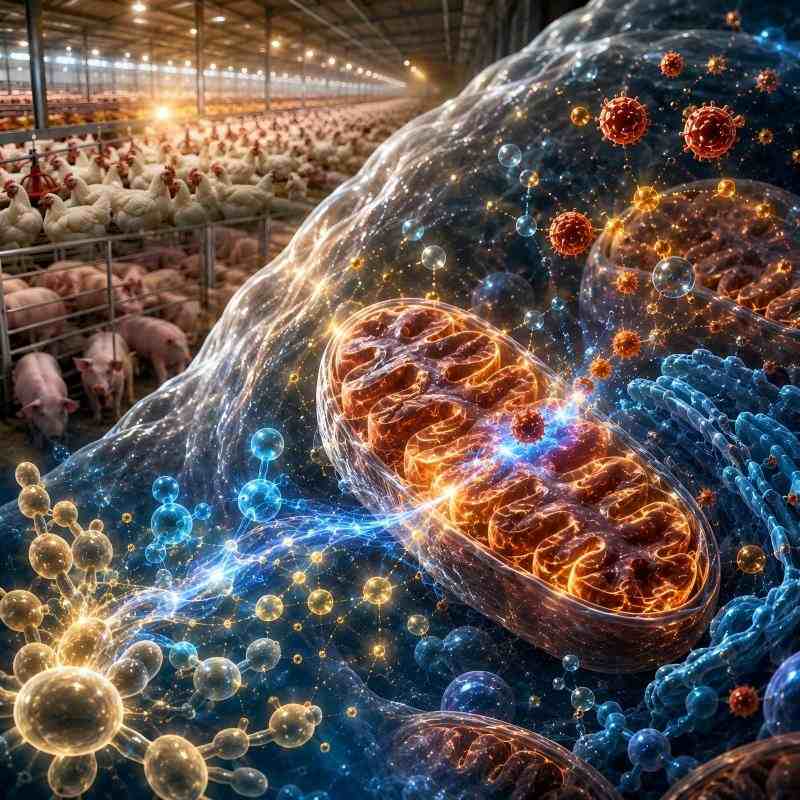
Why Oxidative Stress Is Increasing in Modern Livestock Systems
Modern livestock production systems are designed for maximum biological efficiency. Faster growth cycles, higher feed conversion targets, and continuous production intensity have significantly increased metabolic demand across poultry, swine, and ruminant operations.
As cellular metabolism accelerates, oxygen consumption also increases. During this process, mitochondria naturally generate reactive oxygen species (ROS) as byproducts of energy production.
Under balanced physiological conditions, animals maintain equilibrium between ROS generation and antioxidant defense systems. However, when oxidative pressure exceeds the animal’s regulatory capacity, oxidative stress may gradually develop.
In commercial production systems, oxidative pressure is commonly associated with:
- High stocking density
- Rapid growth intensity
- Environmental fluctuations
- Feed transition pressure
- Long production cycles
- Continuous metabolic demand
Importantly, oxidative stress is increasingly viewed as a cellular efficiency issue rather than only a health-related problem.
Before visible symptoms emerge, oxidative imbalance may already influence mitochondrial stability, nutrient utilization continuity, and cellular energy allocation efficiency.
As interest in metabolic resilience continues growing, many nutritionists are also evaluating how Saccharomyces cerevisiae culture may support broader cellular oxidative stability in high-intensity production systems.
What Happens Inside the Cell During Oxidative Stress
Oxidative stress begins at the cellular level long before visible production problems appear.
Inside animal cells, mitochondria convert nutrients into ATP through oxidative metabolism. During this process, small amounts of ROS are naturally produced. Under excessive metabolic pressure, however, ROS accumulation may exceed the cell’s antioxidant defense capacity.
Once oxidative imbalance develops, several biological processes may be affected:
- Mitochondrial membrane instability
- Lipid peroxidation within cell membranes
- Oxidative protein modification
- Reduced membrane fluidity
- Cellular energy diversion toward stress adaptation
- Disruption of cellular redox balance
One of the most important consequences is mitochondrial oxidative instability.
Because mitochondria regulate cellular energy production, oxidative disruption may reduce ATP synthesis efficiency while increasing maintenance energy demand at the cellular level.
Over time, animals may gradually divert more metabolic resources toward oxidative adaptation and cellular maintenance instead of productive biological functions.
Why Endogenous Antioxidant Enzymes Matter More Than Single Antioxidant Inputs
Traditional antioxidant strategies in animal nutrition have often focused on direct supplementation with compounds such as vitamin E or synthetic antioxidant agents.
While these ingredients remain important in feed formulation, direct antioxidant inputs may gradually lose activity during:
- Thermal processing
- High-temperature pelleting
- Extended storage
- Long-distance transportation
- Premix holding periods
As a result, the industry is increasingly shifting toward endogenous oxidative regulation strategies rather than relying exclusively on single external antioxidant additions.
Endogenous antioxidant enzymes — including superoxide dismutase (SOD), glutathione peroxidase (GSH-Px), and catalase (CAT) — form the animal’s primary biological antioxidant defense network.
Unlike direct antioxidant compounds that function through one-time oxidative neutralization, endogenous enzyme systems continuously participate in cellular redox regulation and oxidative balance maintenance.
For this reason, many feed formulators are increasingly discussing oxidative management in terms of long-term oxidative continuity rather than short-term antioxidant intensity alone.
This shift is also increasing interest in fermentation-derived nutritional approaches associated with supporting the animal’s own antioxidant regulatory systems.
For example, producers evaluating YIDAKANG – General Use are increasingly interested in biological nutritional strategies designed to support oxidative resilience under commercial production pressure.
How Yeast Culture May Support Oxidative Stability Through Multiple Metabolic Pathways
Modern yeast culture products are increasingly recognized as sources of biologically active fermentation metabolites rather than simple microbial ingredients alone.
Depending on the fermentation process and substrate system, yeast culture may contain:
- Fermentation-derived peptides
- Organic acids
- Bioactive metabolites
- Yeast cell wall fractions
- Small molecular nutritional compounds
These metabolites are increasingly studied for their potential associations with:
- Cellular oxidative balance
- Mitochondrial metabolic stability
- Endogenous antioxidant enzyme activity
- Cellular redox regulation
- Metabolic adaptation continuity
Emerging nutritional research also increasingly discusses the role of the Nrf2 (Nuclear Factor Erythroid 2-Related Factor 2) signaling pathway as a central regulator of endogenous antioxidant enzyme expression, including SOD, GSH-Px, and CAT.
Fermentation-derived metabolites found in yeast culture are being investigated for their potential association with cellular signaling pathways involved in oxidative balance regulation and redox adaptation.
Rather than functioning as direct antioxidant replacements, yeast-derived metabolites may help support broader oxidative resilience through multi-pathway biological interactions linked to endogenous antioxidant continuity.
Problem → Mechanism → Outcome
| Production Pressure | Cellular Mechanism | Functional Consequence | Potential Yeast-Associated Functional Support |
|---|---|---|---|
| High metabolic intensity | Excess ROS accumulation | Mitochondrial oxidative instability associated with lower ATP synthesis efficiency | Provides fermentation-derived metabolic cofactors associated with mitochondrial oxidative stability |
| Environmental fluctuation | Lipid membrane oxidation | Reduced cellular oxidative stability and membrane integrity | Associated with support of endogenous antioxidant enzyme systems involved in intracellular redox regulation |
| High-density production | Elevated oxidative maintenance demand | Higher cellular energy diversion toward stress adaptation | Supports oxidative adaptation continuity during prolonged metabolic pressure |
| Continuous production pressure | Oxidative protein modification | Reduced metabolic adaptation efficiency | Associated with maintenance of cellular oxidative balance and metabolic stability |
| Long-term oxidative exposure | Cellular redox imbalance | Increased oxidative maintenance burden | Supports long-term oxidative resilience through multi-pathway fermentation metabolites |
Why Oxidative Stability Matters Beyond Animal Health
Oxidative stability is increasingly important not only for animal physiology, but also for downstream production economics and product quality continuity.
In commercial meat production systems, oxidative imbalance may contribute to:
- Lipid oxidation
- Tissue oxidative deterioration
- Meat color instability
- Shelf-life reduction
- Increased drip loss risk during storage
For integrators and meat processors, oxidative deterioration may directly influence product consistency, cold-chain performance, and retail presentation quality.
As global markets continue emphasizing quality stability and processing continuity, nutritional approaches associated with oxidative balance management are attracting broader industry attention.
This is particularly relevant in intensive poultry and swine systems, where producers are increasingly integrating oxidative management concepts into broader poultry nutrition programs and swine production strategies designed for long-term production continuity.
The Shift Toward Biological Oxidative Management
Global feed production systems are gradually shifting toward more biologically integrated nutritional strategies.
At the same time, feed manufacturers face increasing pressure related to:
- Thermal processing stability
- Long storage cycles
- International transportation conditions
- Regulatory pressure on synthetic additives
- Demand for natural functional nutrition
As a result, interest in fermentation-derived ingredients capable of supporting broader metabolic regulation functions continues growing across the industry.
Within this trend, yeast culture metabolites are increasingly discussed as part of a biological oxidative management strategy associated with:
- Cellular oxidative resilience
- Metabolic continuity
- Mitochondrial stability
- Endogenous antioxidant regulation
- Production adaptation efficiency
Rather than approaching oxidative stress solely as a short-term antioxidant issue, modern nutrition programs increasingly evaluate oxidative balance as a continuous cellular management challenge throughout the production cycle.
Conclusion
Oxidative stress is increasingly recognized as a hidden metabolic cost within modern high-intensity livestock production systems.
Before visible production decline occurs, excessive oxidative pressure may already influence mitochondrial efficiency, membrane stability, cellular redox balance, and metabolic resource allocation at the cellular level.
For this reason, the industry is gradually moving beyond isolated antioxidant supplementation toward broader biological oxidative management strategies.
Yeast culture metabolites are increasingly studied for their potential role in supporting endogenous antioxidant continuity, oxidative resilience, and metabolic stability through multi-pathway biological interactions.
As livestock systems continue evolving toward greater production intensity, oxidative balance management may become an increasingly important component of long-term nutritional efficiency and production continuity strategies.