
Many livestock producers have experienced the same pattern:
after introducing a new feed additive or nutritional strategy, performance improves quickly — feed conversion gets better, daily gain increases, or health indicators stabilize. But after several weeks, progress slows. Eventually, performance reaches a plateau.
This plateau often raises concerns about product effectiveness. However, in most commercial systems, the issue is not that the product stops working — it’s that the biological system has adapted faster than the feeding strategy evolves.
Understanding why this happens is the first step toward sustaining long-term performance gains.
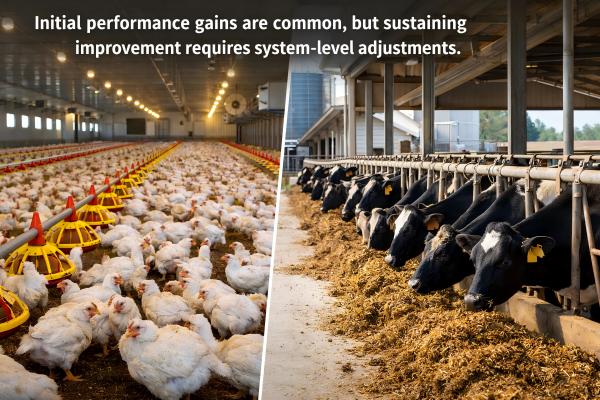
What a “Performance Plateau” Really Means in Livestock Production
A performance plateau does not mean production is declining. Instead, it signals that animals have reached the maximum output possible under the current nutritional, environmental, and management conditions.
Common plateau indicators include:
-
Feed Conversion Ratio (FCR) no longer improving
-
Average Daily Gain (ADG) stabilizing
-
Milk yield or egg mass leveling off
-
Health remaining stable, but performance no longer advancing
In other words, the initial bottleneck has been resolved — but a new limiting factor has taken its place.
Reason #1: Animals Adapt Faster Than Feeding Programs Anticipate
One of the most overlooked realities in animal production is how quickly animals adapt to nutritional inputs.
Gut Microbiota Reach a New Steady State
When functional additives such as yeast culture or fermentation products are introduced, the gut environment often improves rapidly. Fiber degradation becomes more efficient, rumen or intestinal stability increases, and pathogenic pressure decreases.
However, within a few weeks, the gut microbiota typically reaches a new, stable equilibrium. Once this balance is established, the same additive delivers maintenance benefits rather than continued incremental gains. The system is no longer “improving” — it is stabilizing.
This explains why producers often see strong early responses followed by a leveling of performance, a phenomenon explored in more detail in Why Yeast Culture Doesn’t Always Improve Feed Efficiency.
Metabolic Systems Also Adapt
Adaptation is not limited to the gut. The liver and metabolic enzyme systems respond to sustained nutritional inputs by optimizing nutrient utilization pathways. Over time, enzyme activity adjusts, metabolic efficiency improves, and the marginal response to the same nutritional stimulus declines.
At this stage, plateauing performance reflects biological efficiency — not failure.
Reason #2: Feed Additives Are Treated as a Switch, Not a System
A common mistake is expecting feed additives to deliver continuous improvements without adjusting the surrounding diet.
In practice:
-
Additives are introduced
-
Base diet structure remains unchanged
-
Energy density, protein balance, and fiber composition stay the same
The result is predictable: early gains followed by stagnation. Functional additives perform best when they are part of a coordinated nutritional system, not a standalone solution.
Reason #3: Static Dosage in a Dynamic Production Cycle
Production demands are not constant across growth stages, lactation phases, or stress periods. Yet additive dosage often remains fixed.
What works during early growth may be insufficient during peak production. Conversely, higher-output stages may require different functional emphasis rather than simply more of the same product.
When dosage strategies fail to evolve, plateaus are almost inevitable.
Reason #4: Management and Environment Become the New Bottlenecks
Once nutritional limitations are addressed, non-nutritional constraints often emerge as the dominant performance limit:
-
Heat stress
-
Stocking density
-
Water quality
-
Transition stress or immune challenges
At this point, additional nutritional input alone rarely breaks the plateau.
Why “More of the Same” Rarely Solves the Problem
Increasing dosage, switching brands without changing strategy, or stacking multiple additives often increases cost without restoring performance momentum.
These approaches treat symptoms rather than addressing the next limiting factor in the system.
How to Move Beyond the Plateau: From Results to Process Monitoring
Breaking through a performance plateau requires a shift in how performance is evaluated.
Most producers focus on result-based metrics such as FCR or milk yield. While important, these are lagging indicators — by the time they change, the plateau has already formed.
A more effective strategy is to incorporate process-level indicators, including:
-
Feed intake curve stability rather than average intake alone
-
Fecal consistency and digestibility indicators
-
Activity and behavioral patterns that signal metabolic or digestive stress
These early signals often reveal constraints before production metrics flatten. Monitoring them allows adjustments in formulation, dosage, or functional focus before performance stalls completely.
Applying Functional Solutions the Right Way
Products such as Saccharomyces Brewing Yeast Culture are designed to support gut stability, fermentation efficiency, and metabolic resilience.
However, their greatest value comes not from isolated use, but from:
-
Proper alignment with diet structure
-
Stage-specific application strategies
-
Ongoing performance monitoring and adjustment
This is also why performance timelines can vary, as discussed in How Long Does It Take for Yeast Culture to Show Results?.
Conclusion: Plateaus Are Signals, Not Setbacks
Performance plateaus are a natural outcome in biological systems. They indicate that one constraint has been resolved — and another is waiting to be addressed.
Producers who achieve sustained improvement do not chase short-term boosts. Instead, they treat plateaus as diagnostic signals, using data, observation, and system-level adjustments to unlock the next level of performance.
If you’re experiencing a performance plateau and want a technical evaluation tailored to your species, diet structure, and production stage, our team can help.
Contact us to discuss your feeding strategy and performance goals
FAQs
Q1: Why does livestock performance improve first and then plateau?
Initial improvements usually occur when a major nutritional or health limitation is resolved. Over time, animals adapt biologically, and new limiting factors such as diet structure, management, or environment take over.
Q2: Does a performance plateau mean the feed additive stopped working?
Not necessarily. In most cases, the additive continues to provide stability and maintenance benefits, but additional gains require system-level adjustments rather than more of the same input.
Q3: How long does it take for livestock to reach a performance plateau?
In many commercial systems, plateaus can appear within several weeks after an initial improvement, especially once gut microbiota and metabolic systems reach a new stable balance.
Q4: What indicators signal an upcoming performance plateau?
Early signals often include changes in feed intake stability, fecal consistency, or animal behavior—well before metrics like FCR or production output begin to flatten.
Q5: How can producers break through a performance plateau?
Breaking a plateau typically requires adjusting diet structure, aligning additive function with production stage, and shifting from result-only metrics to process-level monitoring.
Q6: Are yeast culture and fermentation products still useful after a plateau?
Yes. These products continue to support gut stability and resilience, but their role shifts from driving rapid gains to sustaining performance under optimized conditions.