
Introduction
Fermentation technology has become a core part of modern animal nutrition, especially in the development of functional feed additives. However, many buyers and nutritionists face a common challenge:
Why do products labeled as “fermented” deliver completely different results?
In reality, not all fermentation technologies are the same. Differences in process control, microbial systems, and raw materials can lead to significant variations in performance, stability, and cost-effectiveness.
Understanding how fermentation technology works—and how different methods compare—is essential for making better purchasing decisions.
What Is Fermentation Technology in Animal Nutrition?
Fermentation in animal feed involves the use of microorganisms such as yeast or bacteria to transform raw materials into more functional and bioavailable compounds.
Through controlled microbial activity, fermentation can:
- Produce beneficial metabolites such as enzymes, organic acids, and peptides
- Improve nutrient digestibility
- Support gut health and microbial balance
Today, fermentation is widely used in products such as yeast culture, probiotics, and plant-based fermented additives.
If you want a deeper understanding of how these processes function inside animals, you can explore our related guide on how yeast works in the gut environment.
Main Types of Fermentation Technologies Used in Feed Industry
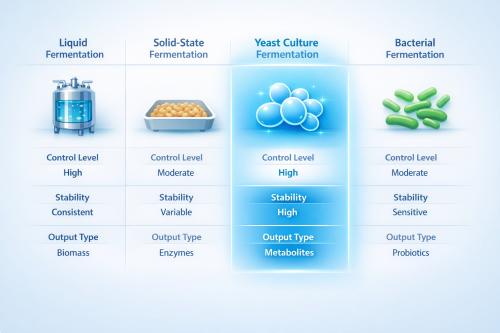
1. Liquid Fermentation (Submerged Fermentation)
Liquid fermentation is one of the most widely used industrial methods. It involves growing microorganisms in a controlled liquid medium.
Advantages:
- High level of process control
- Consistent product quality
- Suitable for large-scale production
Limitations:
- Higher production costs
- Requires advanced equipment and strict parameter control
This method is often used for high-quality, standardized feed additives.
2. Solid-State Fermentation
Solid-state fermentation operates in a low-moisture environment, often using agricultural substrates such as bran or plant materials.
Advantages:
- Lower production cost
- More natural fermentation conditions
Limitations:
- Greater batch-to-batch variability
- Difficult to standardize
- Limited process control
While cost-effective, this method may result in inconsistent performance, especially in large-scale feed applications.
3. Yeast Culture Fermentation
Yeast culture fermentation is fundamentally different from typical live microorganism products. Instead of focusing on live cells, it emphasizes the metabolites and functional compounds produced during fermentation.
Key characteristics:
- Rich in bioactive metabolites
- Does not rely on microbial survival
- Stable during feed processing
Advantages:
- High stability under heat and storage conditions
- Consistent functional performance
- Suitable for ruminants, swine, and poultry
Compared to live probiotics, yeast culture offers a more reliable solution when stability and consistency are critical.
If you are evaluating options, our Saccharomyces cerevisiae culture product line is designed specifically to deliver stable fermentation-derived benefits across different animal systems.
4. Bacterial Fermentation (Probiotics)
Bacterial fermentation focuses on producing live microorganisms intended to colonize or influence the gut microbiota.
Advantages:
- Direct interaction with gut microbiome
- Potential to improve intestinal balance
Limitations:
- Sensitive to heat during pelleting
- Survival rates can be unpredictable
- Performance depends on environmental conditions
This makes probiotics more variable in real-world feed production environments.
Key Differences That Affect Performance
1. Stability in Feed Processing
One of the most critical factors is how well a product survives feed processing, especially high-temperature pelleting.
- Probiotics often lose activity under heat
- Yeast culture remains stable because it does not depend on live cells
This directly impacts real-world effectiveness.
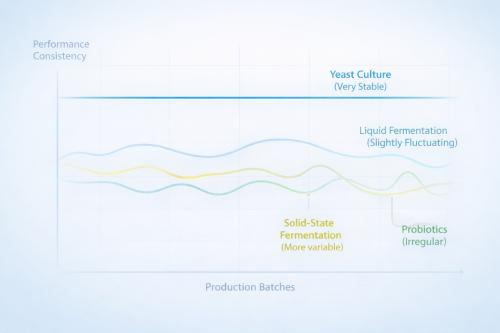
2. Consistency Between Batches
Consistency is essential for both feed manufacturers and end users.
- Liquid fermentation offers better control and uniformity
- Solid-state fermentation may result in fluctuations
- Yeast culture systems with controlled fermentation provide stable outputs
If consistency is a priority, fermentation control becomes a key selection factor.
3. Functional Output (Metabolites)
The value of fermentation products lies in what they produce—not just the microorganisms themselves.
- Yeast culture provides a wide range of metabolites
- Probiotics mainly rely on live microbial activity
- Solid-state fermentation output can vary significantly
For a deeper look at how these metabolites influence performance, you can also read our article on yeast metabolites in rumen microbial balance.
4. Cost vs Value
Lower production cost does not always translate into better value.
- Solid-state fermentation: lower cost, but variable results
- Probiotics: moderate cost, but unstable performance
- Controlled yeast fermentation: higher consistency, better long-term ROI
For buyers, the focus should be on performance consistency rather than initial price.
How to Choose the Right Fermentation Technology
Selecting the right fermentation technology depends on your application goals:
- If you need high stability in feed processing, choose yeast culture
- If you require precise and consistent performance, choose controlled fermentation systems
- If your priority is low cost, solid-state fermentation may be considered
However, in most commercial feed operations, stability and consistency tend to outweigh small cost differences.
Why Advanced Fermentation Control Matters
The effectiveness of any fermentation product ultimately depends on how well the process is controlled.
Key factors include:
- Raw material selection
- Microbial strain management
- Fermentation parameter control
- Post-fermentation stabilization
Advanced fermentation systems ensure that every batch delivers consistent metabolite profiles and predictable performance.
This is why more feed manufacturers are shifting toward controlled fermentation-based solutions rather than relying on traditional or low-cost methods.
Conclusion
Not all fermentation technologies in animal nutrition are created equal.
Differences in fermentation methods directly affect:
- Product stability
- Functional performance
- Batch consistency
- Overall return on investment
Instead of focusing only on product labels, buyers should evaluate the underlying fermentation technology behind the product.
If you are looking for a more stable and reliable fermentation-based solution, feel free to contact us for technical support or customized recommendations based on your application needs.