
Introduction
Efficient digestion is essential for feed utilization, animal growth, and production performance. Digestive enzymes in animal nutrition, including amylase, protease, and lipase, break down carbohydrates, proteins, and fats so that nutrients can be absorbed and utilized.
However, yeast culture and digestive enzymes do not serve the same function. Yeast culture is not a conventional enzyme additive designed to provide a defined level of amylase, protease, or lipase. Its potential role in digestion is mainly associated with supporting the gastrointestinal environment, microbial activity, and nutrient utilization.
Understanding this distinction is important when evaluating yeast digestive enzymes, yeast culture, and commercial digestive enzyme additives for animal feed formulations.
What Are Digestive Enzymes in Animal Nutrition?
Digestive enzymes are biological catalysts that break down feed nutrients into smaller compounds that animals can absorb and use.
The main enzymes involved in livestock digestion include:
| Enzyme | Main function | Nutritional role |
|---|---|---|
| Amylase | Breaks down starch and carbohydrates | Supports carbohydrate digestion |
| Protease | Breaks down proteins into peptides and amino acids | Supports protein utilization |
| Lipase | Breaks down dietary fats | Supports fat and energy utilization |
The activity of these enzymes depends on more than the presence of the enzymes themselves. Feed composition, digestive conditions, intestinal function, and microbial activity can all affect how efficiently nutrients are processed.
This is why nutritional strategies for improving digestion may involve both direct enzyme supplementation and feed additives that support the digestive environment.
Does Yeast Culture Contain Digestive Enzymes?
When discussing yeast digestive enzymes, it is important to distinguish between enzymes produced by yeast and the function of a yeast culture product in animal feed.
Yeasts have their own metabolic enzyme systems, and some yeast species can produce enzymes involved in the utilization of different substrates. However, this does not mean that a Saccharomyces cerevisiae culture functions as a commercial digestive enzyme preparation.
For example, the question “does yeast produce a starch-digesting enzyme?” cannot be answered simply by treating all yeast products as enzyme additives. Certain yeast species can produce enzymes associated with substrate degradation, but the primary nutritional role of Saccharomyces cerevisiae culture in animal feed is not to provide a standardized source of starch-digesting enzyme activity.
For feed formulation, the distinction is more practical:
- Digestive enzyme additives provide specific enzymatic activity against targeted feed components.
- Yeast culture primarily provides fermentation-derived components that may support the digestive environment and nutrient utilization.
- The two approaches can therefore have different, and potentially complementary, formulation objectives.
This distinction prevents yeast culture from being incorrectly treated as a direct replacement for commercial amylase, protease, or other enzyme preparations.

How Does Yeast Culture Influence Digestive Enzyme Activity?
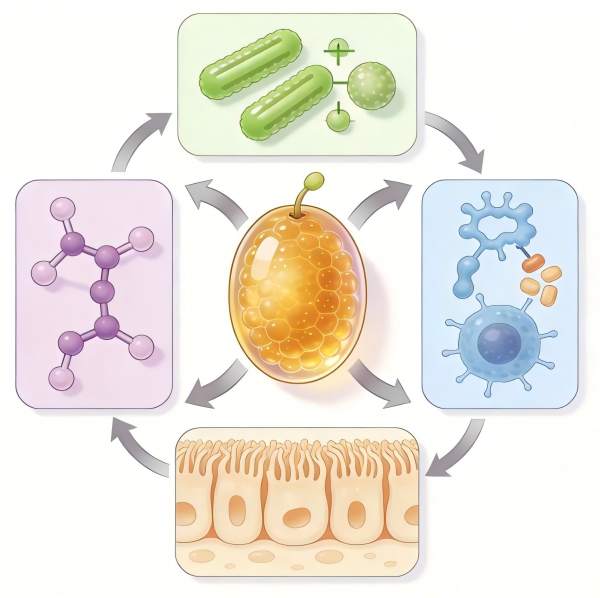
The relationship between yeast culture and digestive enzyme activity is primarily indirect. Rather than acting as a conventional enzyme supplement, yeast culture may help create conditions that support more efficient digestion and nutrient utilization.
Supporting the Gut Microbial Environment
The gastrointestinal microbiota plays an important role in digestive function and nutrient utilization. Fermentation-derived components from yeast culture may support a more stable microbial environment, helping maintain conditions favorable to normal digestive processes.
This can be particularly relevant when animals experience changes in diet, feed variability, or nutritional stress.
The broader relationship between yeast culture and microbial balance is discussed in How Yeast Culture Supports Gut Microbiota in Livestock.
Supporting Intestinal Function
Efficient digestion also depends on a functional intestinal environment. Yeast culture may support intestinal function and nutrient absorption by contributing to a favorable gastrointestinal environment.
The potential effect should therefore be understood as an indirect contribution to digestion rather than direct supplementation of digestive enzymes.
Providing Fermentation-Derived Components
Controlled fermentation produces a range of yeast-derived and fermentation-associated components. Depending on the production process, these may contribute to the nutritional environment of the gastrointestinal tract.
Because yeast culture products can differ in composition and production method, their digestive effects should be evaluated based on product specifications, application rate, and supporting evidence rather than assuming that all yeast products have identical functionality.
Supporting Nutrient Utilization
When digestive conditions are stable, animals may be better able to utilize nutrients supplied by the formulated diet.
This is one reason yeast culture is generally evaluated as part of a broader nutritional strategy rather than as a substitute for a specific digestive enzyme.
Yeast Culture vs. Digestive Enzyme Additives
For feed manufacturers and nutritionists, the most useful question is not whether yeast culture or enzymes are universally better. The more important question is which function the formulation requires.
| Consideration | Yeast Culture | Digestive Enzyme Additives |
| Primary role | Supports the digestive and microbial environment | Provides specific enzymatic activity |
| Main action | Primarily indirect | Direct enzymatic breakdown |
| Typical target | Digestive stability and nutrient utilization | Specific feed components |
| Key evaluation factors | Fermentation process, composition, application rate, evidence | Enzyme activity, substrate specificity, stability, dosage |
| Formulation position | Broader nutritional support | Targeted enzyme functionality |
For example, a formulation may use amylase when the objective is to improve starch breakdown, while yeast culture may be considered when broader digestive and microbial support is desired.
In some feed programs, both approaches may be evaluated according to species, diet composition, production stage, and formulation objectives. However, their functions should remain clearly differentiated.
For applications where enzyme functionality is specifically incorporated into a fermentation-based feed solution, see Enzyme PLUS.
Benefits of Yeast Culture for Feed Digestibility
The potential digestive benefits of yeast culture are best understood as outcomes of supporting the digestive environment rather than as direct enzyme supplementation.
Depending on the product and feeding conditions, potential benefits may include:
- Improved feed digestibility through more favorable digestive conditions
- Better nutrient utilization when digestive and intestinal functions are supported
- Greater digestive stability during dietary or production changes
- Improved feed efficiency when more effective nutrient utilization contributes to better use of the formulated diet
Actual responses depend on animal species, feed composition, production conditions, inclusion rate, and product characteristics. Therefore, feed manufacturers should evaluate yeast culture using application-specific evidence rather than relying on generalized claims about enzyme activity.
Applications in Livestock Nutrition
The relationship between yeast culture and digestion varies according to animal species and feeding system.
Poultry
In poultry production, yeast culture may be evaluated as part of a nutritional strategy supporting digestive conditions and nutrient utilization, particularly in grain-based diets where efficient carbohydrate and protein utilization are important.
Swine
In swine diets, yeast culture can be considered for digestive stability and nutrient utilization, particularly when animals experience dietary transitions or changing nutritional demands.
Ruminants
In ruminants, the digestive process depends heavily on rumen microbial fermentation. Yeast-derived fermentation products are therefore evaluated primarily for their potential contribution to rumen microbial activity and feed utilization rather than as direct sources of digestive enzymes.
What Feed Manufacturers Should Consider
When evaluating yeast culture for digestive applications, several factors are more useful than simply looking for an “enzyme” claim.
Product Definition
Determine whether the product is a yeast culture, live yeast, yeast-derived ingredient, enzyme preparation, or a combination product.
Functional Mechanism
Identify whether the intended benefit comes from direct enzyme activity or from supporting the digestive and microbial environment.
Formulation Objective
If the formulation requires targeted breakdown of starch, protein, fiber, or another feed component, a specific enzyme may be more appropriate. If the objective is broader digestive and microbial support, yeast culture may provide a complementary approach.
Supporting Evidence
Evaluate product performance according to animal species, diet composition, inclusion rate, production stage, and available application data.
These considerations help manufacturers distinguish the role of yeast culture from that of conventional digestive enzyme additives and select products according to actual formulation requirements.
Conclusion
Yeast digestive enzymes should not be interpreted as meaning that yeast culture functions as a conventional digestive enzyme preparation. Although yeasts have their own metabolic enzyme systems and some yeast species can produce enzymes involved in substrate utilization, Saccharomyces cerevisiae culture used in animal feed is primarily evaluated for its fermentation-derived components and their potential effects on the digestive environment.
The practical distinction is between direct enzyme supplementation and the indirect digestive support provided by yeast culture.
When a feed formulation requires targeted enzymatic breakdown, a defined digestive enzyme additive may be appropriate. When the objective includes broader support for digestive stability, microbial activity, and nutrient utilization, yeast culture may provide a complementary nutritional strategy.
For more information about yeast culture products and their applications in animal nutrition, feel free to contact our team to discuss suitable solutions for your feed programs.