
Modern livestock production faces increasing immune challenges. Disease pressure, environmental stress, and the global reduction of antibiotic use have made immune resilience a critical factor in maintaining animal health and performance.
Producers and nutritionists are increasingly looking for nutritional strategies that support the immune system without relying on antibiotics. Among these strategies, Saccharomyces cerevisiae culture has gained significant attention for its ability to regulate immune responses while simultaneously supporting gut health.
But how does yeast culture actually influence the immune system? The answer lies in several biological mechanisms involving gut microbiota, immune cell activation, intestinal barrier integrity, and inflammation regulation.
What Is Yeast Culture?
Yeast culture is a fermentation-derived product created by growing Saccharomyces cerevisiae under controlled conditions and then preserving both the yeast cells and the beneficial metabolites produced during fermentation.
Unlike live yeast products that primarily act through microbial activity, yeast culture contains a complex mixture of bioactive compounds, including:
-
β-glucans
-
Mannan oligosaccharides (MOS)
-
Fermentation metabolites
-
Peptides and organic acids
-
Vitamins and micronutrients
These components interact with the gut ecosystem and immune system in multiple ways, creating a broader functional impact than a single active ingredient.
The Gut–Immune System Connection
A large proportion of the animal immune system is closely linked to the digestive tract. In many species, over 70% of immune cells are associated with the gut-associated lymphoid tissue (GALT).
Because the intestinal tract is constantly exposed to microbes, toxins, and dietary components, it acts as the first line of immune defense. The balance of gut microbiota, the integrity of the intestinal barrier, and the interaction between microbes and immune cells all influence immune function.
For this reason, feed additives that improve gut health often play an important role in supporting immune regulation.
Yeast culture exerts its immune-modulating effects largely through this gut–immune interaction.
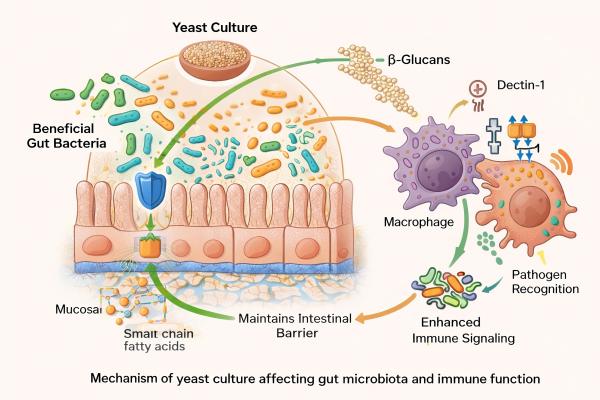
Mechanism 1: Modulation of Gut Microbiota
One of the primary ways yeast culture supports immunity is by influencing the balance of intestinal microorganisms.
Fermentation metabolites and yeast-derived nutrients can stimulate the growth of beneficial bacteria while limiting the proliferation of pathogenic microbes. This shift in microbial populations helps create a more stable intestinal environment.
A balanced microbiota can contribute to:
-
reduced pathogen colonization
-
improved nutrient digestion
-
better microbial metabolite production
These changes indirectly support immune function because the gut microbiota plays an important regulatory role in immune signaling and pathogen defense.
Mechanism 2: Activation of Innate Immune Responses
Another important mechanism involves the interaction between yeast cell wall components and immune cells.
β-glucans present in yeast culture can bind to immune receptors such as Dectin-1 and certain Toll-like receptors located on macrophages and other innate immune cells. This interaction stimulates immune signaling pathways that improve pathogen recognition and defensive responses.
In simple terms, β-glucans can act like a form of “training signal” for immune cells, helping them respond more efficiently when real pathogens appear.
Emerging research also suggests that β-glucans may contribute to trained immunity—a functional reprogramming of innate immune cells that enhances their response to future immune challenges.
Rather than overstimulating the immune system, this process helps animals maintain a more prepared and balanced immune response.
Mechanism 3: Strengthening the Intestinal Barrier
The intestinal barrier is another critical component of immune defense.
The gut lining contains tight junction proteins that regulate what can pass from the intestinal lumen into the bloodstream. When this barrier becomes compromised, pathogens and toxins can enter the body more easily, triggering inflammation and immune stress.
Yeast culture has been shown to support intestinal integrity by helping maintain tight junction function and supporting mucosal immunity.
A stronger intestinal barrier means:
-
fewer pathogens crossing into the bloodstream
-
reduced immune stress
-
improved overall resilience in animals exposed to environmental challenges
In practical terms, a stronger gut barrier often translates into a more stable immune system.
Mechanism 4: Reduction of Inflammation and Oxidative Stress
In addition to stimulating immune readiness, yeast culture can also help regulate excessive inflammatory responses.
Fermentation metabolites and yeast-derived compounds may contribute to improved antioxidant status and balanced immune signaling. Another important factor is the production of beneficial microbial metabolites such as short-chain fatty acids (SCFAs).
As discussed in our article on yeast culture and short-chain fatty acid production, compounds such as butyrate play a direct role in regulating inflammatory signaling pathways and maintaining intestinal health.
By supporting the production of these metabolites, yeast culture helps maintain immune balance rather than simply stimulating immune activity.
Practical Benefits in Livestock Production
The mechanisms described above translate into several practical benefits across different livestock species.
Poultry
In poultry production, yeast culture can help support gut health and immune readiness, particularly during periods of stress or disease challenge. Improved immune responsiveness may contribute to better vaccine outcomes and more uniform flock protection.
At the same time, improved intestinal stability can help maintain feed efficiency and overall performance.
Swine
In swine production, immune support is particularly important during the weaning stage, when piglets experience significant nutritional and environmental stress.
By supporting gut microbiota balance and immune function, yeast culture can help reduce the risk of post-weaning digestive disorders. Lower diarrhea incidence often means fewer medical treatments and better weight gain during early growth stages.
Ruminants
In ruminant systems, yeast culture is commonly associated with rumen microbial stability, but its benefits can also extend to immune resilience.
Improved microbial balance and nutrient utilization may contribute to better overall health and stronger resistance to environmental stressors in both dairy and beef production systems.
Choosing a High-Quality Yeast Culture Product
Not all yeast culture products provide the same functional benefits. Product quality largely depends on the fermentation process and the consistency of the resulting metabolite profile.
Key factors that influence product quality include:
-
controlled fermentation conditions
-
stable and consistent metabolite composition
-
sufficient concentration of functional compounds
-
reliable batch-to-batch consistency
For a deeper explanation of these factors, see our guide on what makes a high-quality Saccharomyces cerevisiae culture.
Understanding these differences can help nutritionists and producers select yeast culture products that deliver reliable performance in commercial livestock production.
Conclusion
Yeast culture supports immune modulation through multiple biological pathways. Rather than acting through a single mechanism, it influences the immune system through an integrated set of effects.
These include:
-
modulation of gut microbiota
-
activation of innate immune responses
-
strengthening of the intestinal barrier
-
regulation of inflammation and oxidative stress
Together, these mechanisms help animals maintain a balanced immune response while improving resilience to environmental and microbial challenges.
If you are evaluating yeast culture as part of your feed strategy, you can contact our team for application guidance and explore how fermentation-based solutions may support immune health in modern livestock production.