
Introduction: Why SCFAs Matter More Than You Think
In modern livestock production, issues such as inconsistent feed efficiency, gut health challenges, and performance fluctuations are becoming increasingly common—especially as antibiotic use continues to decline.
With antibiotic reduction programs expanding globally, the role of naturally produced SCFAs in maintaining gut stability has shifted from background physiology to frontline strategy.
Short-chain fatty acids (SCFAs) are no longer just a byproduct of digestion—they are a key driver of gut function, microbial balance, and overall animal performance.
This is where yeast culture becomes highly relevant—not as a direct source of nutrients, but as a powerful modulator of microbial fermentation.
What Are Short-Chain Fatty Acids (SCFAs)?
Short-chain fatty acids mainly include acetate, propionate, and butyrate. They are produced by microbial fermentation of undigested feed components in the gut.
Their functions go far beyond basic digestion:
-
Provide energy for intestinal cells
-
Regulate gut pH
-
Inhibit harmful bacteria
-
Strengthen intestinal barrier function
In simple terms, SCFAs act as a form of functional metabolic currency that supports gut stability and efficiency.
How Yeast Culture Influences SCFA Production
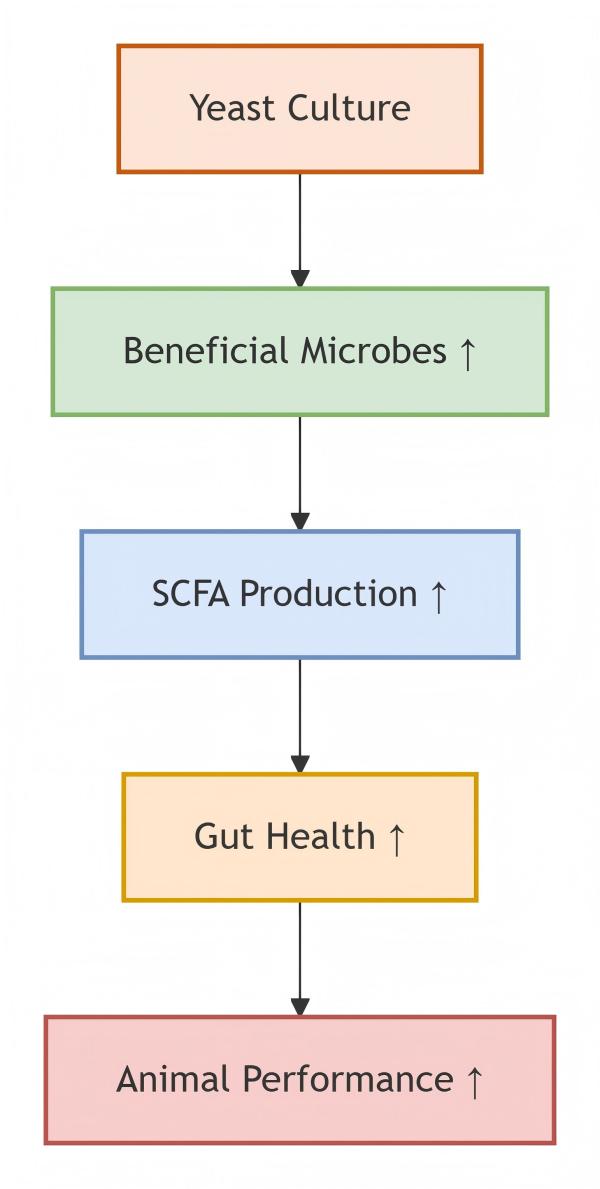
The effect of yeast culture on SCFAs is indirect but highly strategic. It works by reshaping the microbial ecosystem and fermentation pathways.
Step 1: Feeding Beneficial Microbes
Yeast culture provides bioactive compounds such as oligosaccharides, peptides, and fermentation metabolites.
These act as selective substrates that promote the growth of beneficial bacteria.
Step 2: Redirecting Fermentation Pathways
Instead of allowing fermentation to produce excess lactate or gas, yeast culture helps guide microbial activity toward more efficient end-products.
You can think of this as redirecting fermentation “traffic flow”—shifting resources away from less efficient pathways and channeling them toward SCFA production.
Step 3: Increasing SCFA Output (Especially Butyrate)
As microbial efficiency improves, total SCFA production increases—especially butyrate.
Butyrate plays a critical role in:
-
Supporting intestinal cell energy supply
-
Reducing inflammation
-
Enhancing barrier integrity
At this stage, the quality of the yeast culture becomes a key variable. Differences in fermentation metabolites and processing methods can significantly influence outcomes, as discussed in what defines a high-quality Saccharomyces cerevisiae culture.
Why SCFA Improvement Translates into Animal Performance
The benefits of SCFAs are not theoretical—they directly translate into measurable production outcomes.
Feed Efficiency
SCFAs provide an additional energy source that can account for a meaningful portion of maintenance energy requirements (often estimated around 10–15%).
This contributes to better feed conversion and nutrient utilization.
Gut Integrity
Butyrate is the preferred energy source for intestinal epithelial cells, making it essential for maintaining villus structure and repairing gut lining.
A healthier gut structure leads to more stable absorption and reduced leakage.

Microbial Stability
SCFAs help lower gut pH, creating an unfavorable environment for pathogens such as Enterobacteriaceae.
This stabilizes the microbial ecosystem and reduces performance variability.
Application Differences: Poultry vs Swine vs Ruminants
The role of SCFAs varies depending on species and digestive physiology.
Poultry
With a relatively short digestive tract, poultry rely heavily on efficient SCFA production.
Butyrate is particularly important for maintaining intestinal integrity and performance.
Swine
In pig production, SCFAs are especially critical during the weaning phase.
They support gut development, reduce stress, and help stabilize microbiota during dietary transitions.
Ruminants
In ruminants, fermentation already plays a central role in energy supply. Yeast culture helps stabilize rumen fermentation and improve overall efficiency.
For a more detailed explanation of this mechanism, see our discussion on rumen microbial balance.
Practical Considerations: Why Results Vary in the Field
Despite consistent mechanisms, field results can vary due to several factors:
-
Differences in yeast culture quality and metabolite profiles
-
Variations in diet composition (fiber vs starch levels)
-
Animal stage and stress conditions
In practice, the question is not whether yeast culture works, but how effectively it is applied within a specific system.
Conclusion: From Microbial Fermentation to Measurable ROI
Yeast culture influences animal performance through a clear biological chain:
Microbial modulation → SCFA production → gut health → performance improvement
Rather than acting as a direct input, it enhances the efficiency of the entire digestive system.
In practical production systems, improving SCFA production is not about adding a single component, but about optimizing the microbial environment as a whole. If you are evaluating how yeast culture could fit into your feeding program, you can explore more details or discuss your specific application needs through our contact page.